Babbitt’s Footage of the 1938 Oscars

tumblr_lyqttrF7uo1qc33jn

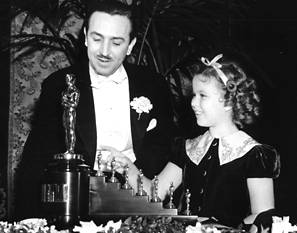
Walt and Shirley Temple at the 1939 Oscars the next year

Happy Oscar season, everyone!

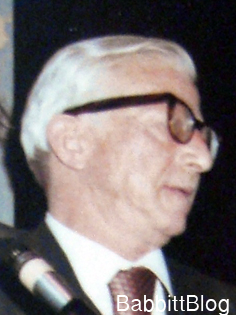
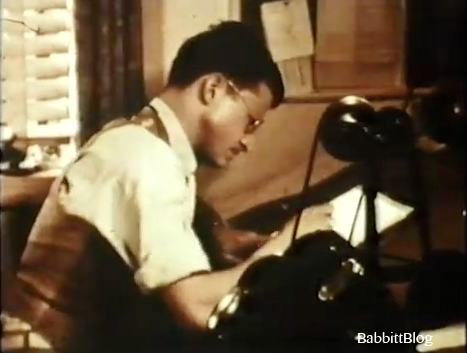
The 10th Academy Awards was a unique event for the Disney Studios: Snow White and the Seven Dwarfs received a nomination for best score, and The Old Mill won for best animated short. It was March 10th, 1938 at the Biltmore Hotel (a week late due to flooding), and Art Babbitt was there with his young wife Marge, a 16mm camera and a roll of COLOR film.

BiltmoreBowl

The bowl of the Biltmore Hotel (at the previous year’s Oscar ceremony)

The Academy is proud to present:

Frank Capra, W. C. Fields, Louis B. Mayer, Luise Rainer

AW_FrankCapra AW-WCFields AW_LouisBMayer AW_LuiseRainer

Louella Parsons, Mack Sennet, Leo McCarey, Cecil B. Demille

AW_LuellaParsons AW_MackSennetAW_LeoMcCarey AW_CecilBDemille

photographer Hymie Fink, Jack Warner,  and Louise (Mrs. Spencer) Tracy

AW_HymieFInkMaybe AW_JackWarnerMaybe AW_Mystery01

Posted in 1932-1941: Disney Glory Days, Animation, Disney, Film, Hollywood, Photography, Snow White and the Seven Dwarfs | Tagged , , , , , , , , , , , , , , , , , | 5 Comments

The Goldfish Story

Perhaps the most well-documented Art Babbitt story is that of the goldfish.

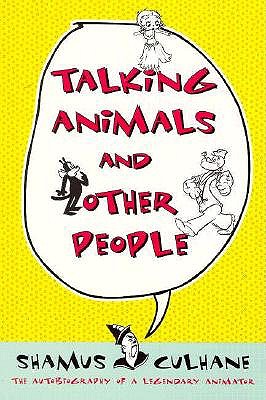
In Talking Animals and Other People (pp. 146-7), Disney animator Shamus Culhane wrote:

Talking-Animals-and-Other-People-Culhane-Shamus-9780306808302In the mid-thirties, nobody in his right mind drank Los Angeles tap water.  It was so full of alkali that it looked like milk and tasted like a drugstore mop.  Disney installed five-gallon bottles of mountain spring water in every room.  The bottles rested on large clay ollas equipped with taps.  Art Babbitt once made the mistake of mentioning casually that his doctor had put him on a regimen that included large quantities of water every day.  Nobody knows who the prankster was, but someone put several goldfish in Babbitt’s spring water.  Everyone waited for the inevitable explosion of wrath, for Babbitt could summon up a temper that made the Terrible Tempered Mr. Bang sound like a mewling kitten.  We waited for three days because the fish, instead of swimming in plain view in the glass bottle, had decided that the darkness of the clay olla suited them better.  Finally, the fish did emerge into the light, and the expected roar from Babbitt shook the building.  For a long time afterward, in the interest of Art’s personal hygiene, nobody told him that he had shared his drinking water with the fish for three days.

Walt Disney and Other Assorted Characters Jack Kinney Art Babbitt Prank

As Illustrated by Disney artist and director Jack Kinney in WALT DISNEY AND ASSORTED OTHER CHARACTERS

Art chuckled at his own version of the story in 1974:

Art Babbitt 1974The animators with three-year contracts got Sparkletts bottles with water in them. And one day I came back from lunch, and just as I was about to take a drink of water, I noticed there were three goldfish swimming in my Sparkletts bottle.

.

As an aside, what is it about these Disney stories that make Chuck Jones, Jack Kinney, Frank Thomas and Ollie Johnston not wish to identify Babbitt?  He certainly wasn’t the only artist there who was the butt of a joke, mastermind of a prank, or was picked on for poor animation planning.  I can’t help but get the impression that they feel they must still tread carefully with anything Art Babbitt.

Posted in 1932-1941: Disney Glory Days, Disney | Tagged , , , | Leave a comment

The Hyperion Horseflies Story

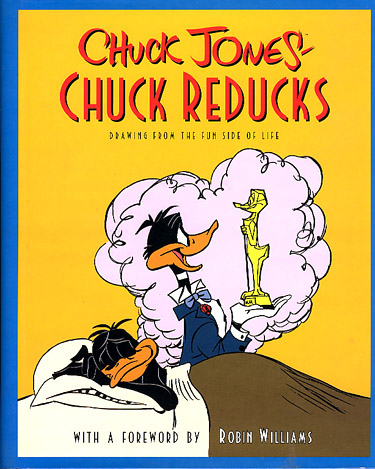
It’s no secret that Chuck Jones and Art Babbitt were good friends from way back.  But in writing about Disney, Chuck borrowed one of Art’s own stories.  In Chuck Reducks (pp. 95-6) he writes:

ChuckReducksLgDisney animators were more likely to play practical jokes on their boss than write him fan letters.  There were stables a short quarter-mile from the old Disney studio, and the hungry horseflies who lived there soon learned that there was food to be had from Disney employees lunching al fresco by the Los Angeles River.  These horseflies were as big as bees, and they gave one alert animator an idea.  He began by netting a few of these muscular insects.  Knowing that Walt Disney and his family were solidly right-wing Republicans, he tore off some long strips of toilet paper, wrote “Vote for Roosevelt” on each one, and glues them to the rear end of the netted flies.  Later that day, he released his miniature squadron in Walt Disney’s quarters, where they flew around trailing their political message and driving Walt’s brother Roy crazy.

On the night of Art’s 50th anniversary as an animator in 1974 (where Chuck was the MC), Art told stories about the pranks at the Disney Studio:

Babbitt1974b… and you put rubber cement on the streamer, and you fasten a streamer to the fly under its wings.  And then like the planes at the beach that drag banners and all these — flies would fly around the room, with streamers on them that said “Vote for Roosevelt.”

Posted in 1932-1941: Disney Glory Days, Disney, Hollywood | Tagged , , , , , | 1 Comment

The “China Shop” Story

Babbitt1934In Frank Thomas and Ollie Johnston’s The Illusion of Life (pp72-73), they tell a story about the struggles of an early Disney cartoon and an anonymous animator.  It was mid-1933 and the artists, especially this particular animator, were much more ambitious than their talents provided.  What they don’t say is that the animator in this story was Art Babbitt. [My highlights are in bold]

.

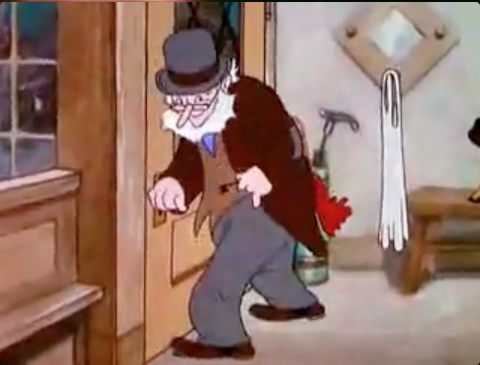
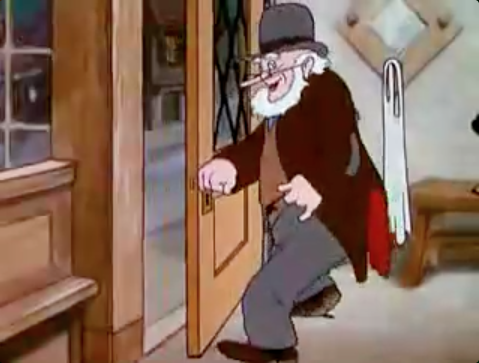
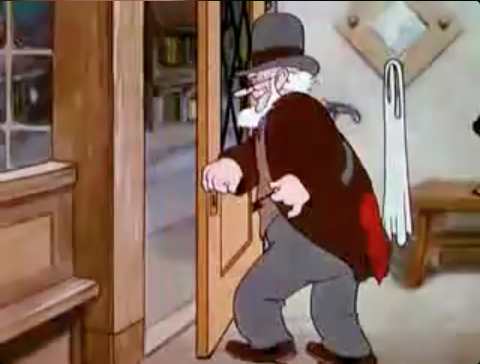
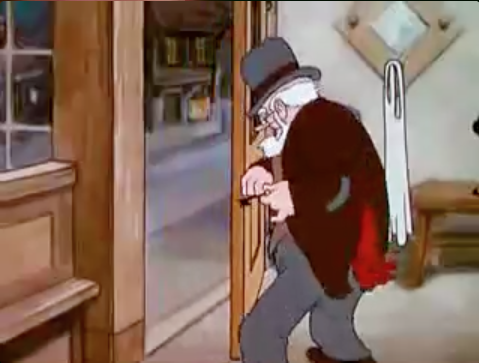
IllusionoflifeThere was a famous scene in The China Shop [released 1/13/34] that was talked about for years,  The story was simple: an old man has a china shop, and when he leaves at night the figurines come to life.  But the scene of the kindly old shopkeeper taking a last look around, then opening the door, walking through it, and closing it behind him was quite a change form the broad gags and actions in the earlier films.  The action not only had to be convincing, it had to have character. […]

The animator was determined to get a shuffling walk, a bent posture, and a feeling of age in the movements.  He did not want this man to reach far, take big steps, or in any way appear to be athletic or strong.  The layout man had drawn a door on a wall that had a true storybook feeling, but, unfortunately, the doorknob was on the far side of the door, a long distance from the elderly shopkeeper.  He had to walk over close enough to reach out easily and grasp it.  But this left him standing directly in the path of the door, which for some reason opened inward!

CS00a CS00b

Two years after this, the animator would have run back to the Music Room [to the director] and screamed about the restricting layout.  […] But this option had not been considered at the time of The China ShopThat animator, with great determination, attacked the problem from an action standpoint, probably hoping secretly that he would show everyone how well he could analyze the situation.

CH01  CS02

The door opened four inches and hit the gentleman’s foot.  He stepped back in a causal, shuffling manner.  He opened the door another four inches only to find that it had bumped against his other foot.

CS03  CS04

Again he stepped back – another four inches.  Now the door was against the first foot once more.

There was no way he could step back far enough into the scene to clear this door, and the farther he backed up the more problem there would be in walking around the obstruction to get outside, where he had to be by the end of the scene.  So as the film rolled by, the poor old man shuffled about endlessly as the door gradually opened enough for him to reverse his step and struggle into the night.  It was a comedy of errors on everyone’s part, but the animator bore the brunt of the kidding more than the director or the layout man.  There was much to be learned.

Frank Thomas told the story at Art’s memorial service in 1992 [at 3:25 in the clip below].

FThomasSmOne of his lows was in […] “The China Shop,” which, when I was at the studio, was a laughing lesson that we all had to watch and see how poorly you can plan a scene and the trouble you can get into thereby.

What had happened was that the old man that ran the store was going home for the night and he says something to the fancy china dishes, “Don’t get into trouble.”  He opens the door but for some reason the door opened into the room instead of out onto the street.  And Art – I don’t know why he accepted the layout that way, but he did – and he first had the guy back up, and the door hit his feet. So he backed up again and the door still hit his feet. So he backed up another one, and he had an awful time getting out of that room. I think he used half the footage of the picture trying to get out through the door.

That was held up to us as an example of POOR PLANNING. Well, that was awfully unkind of them, to pick on Art that way, because it’s obviously a layout error — what could you do? Also, the fire department, I think, said something about the door opening the wrong way, how it’s supposed to open outside.

Well, Art had a key comment on that. He said, “It’s funny how everybody wants to take credit for my successes; no one will have anything to do with my failures.”

Posted in 1932-1941: Disney Glory Days, Animation, Film, Nine Old Men | Tagged , , , , | 1 Comment

“Scotch Highball” Terrytoon draft

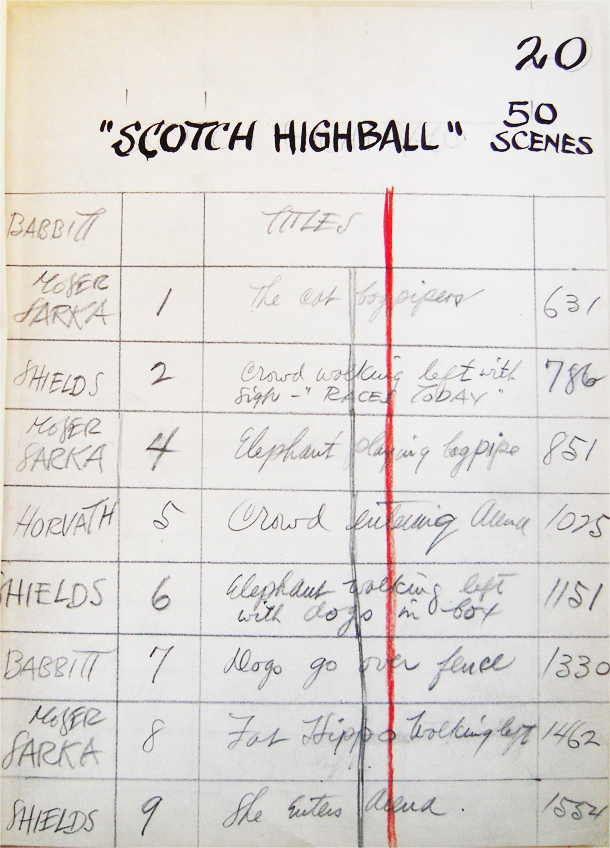
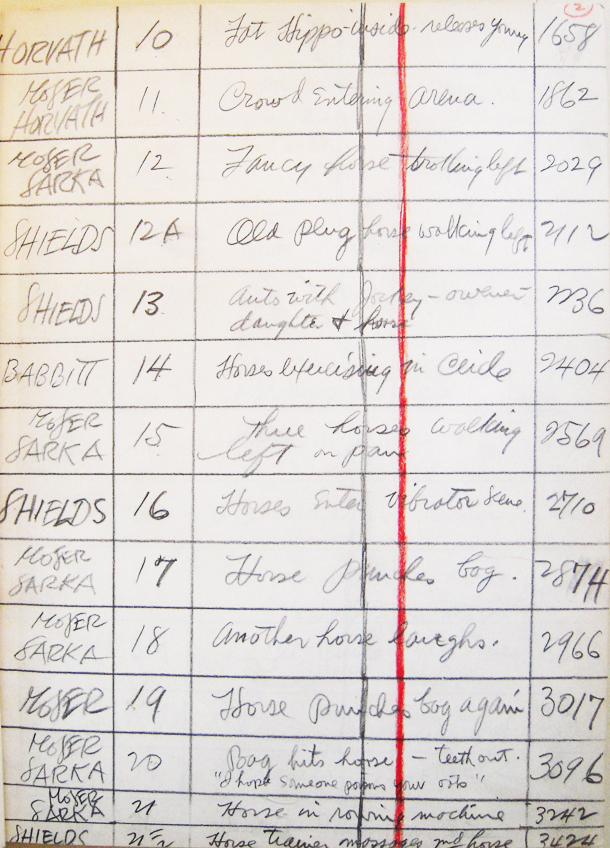
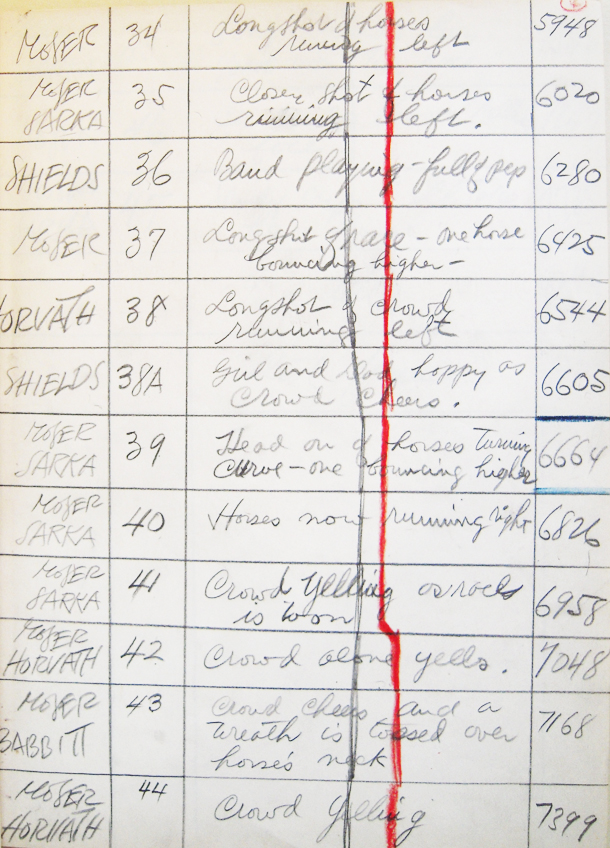
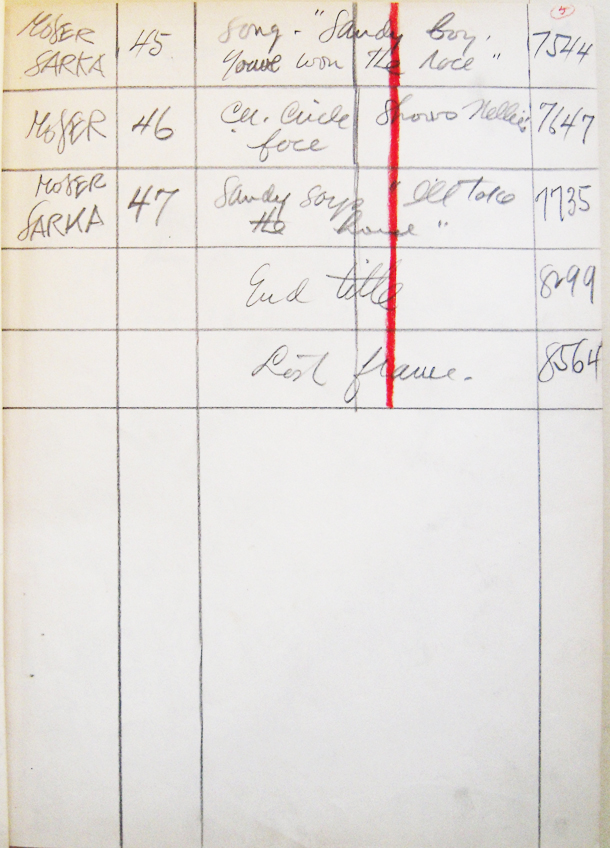
Below are the animators drafts for the Terrytoon cartoon “Scotch Highball,” released November 16, 1930.

Special thanks to Jerry Beck who noted that each Terrytoon short took three weeks to animate, and was released ten weeks later.  We can infer that this cartoon was  animated between August 22 and September 5, 1930.

SH_01 SH_02 SH_03 SH_04 SH_05

Animators assigned are Art Babbitt, Frank Moser, Jerry Shields, Charles Sarka (presumably), Ferd Horvath, and Paul Terry.

Sarka Charles Nicolas Sarka was born in 1879 in Chicago and came to New York as a young adult.  He had painted his way through the South Pacific and was a popular and successful fine artist in New York.  When pop-art hit it big in the ‘teens, his career began a decline.  He became an illustrator for magazines like Blue Book, Collier’s, and later for Harper’s.  During the Depression he took freelance work where he could get it. [1][2][3]

HorvathFerdinand Huszi Horvath was born in Budapest in 1891.  During WWI he spent 2 and a half years in Siberian POW camps.  He joined Paul Terry’s staff at Van Beuren studios by 1926; by the late ’20s he was also a magazine and book illustrator, and exhibited his watercolors and pen sketches to favorable reviews.  Nonetheless, he remained troubled and gave the impression of “the cousin of Dracula.” Soon he would migrate to Disney as a story artist. [4][5]

Terry03Paul Terry was born in 1887, had been a young newspaper illustrator, and joined the animation business in Septemeber of 1920.  With Moser, he left Van Beuren studios in late 1929 and opened up Terrytoons, producing a sound cartoon every two weeks.  He was director and head-writer for all the shorts, and animated on the first dozen, up through “Kangaroo Steak,” released July 27, 1930. [6][7][8]

____________________________________________________

Sources:

  1. http://www.artinsociety.com/sarka-of-the-south-seas.html
  2. http://www.aaa.si.edu/collections/charles-sarka-papers-13424
  3. http://acms.sl.nsw.gov.au/item/itemDetailPaged.aspx?itemID=440576
  4. Before the Animation Begins by John Canemaker, 1996.
  5. http://jimhillmedia.com/alumni1/b/wade_sampson/archive/2004/05/24/1198.aspx
  6. http://tralfaz.blogspot.com/2013/01/1930-cartoons-on-parade.html
  7. Interview with Paul Terry, by Harvey Deneroff, 1969.
  8. Original animator drafts
Posted in 1929-1932: Terrytoons, Animation, New York | Tagged , , , , , , , , | 2 Comments

“Canadian Capers” draft

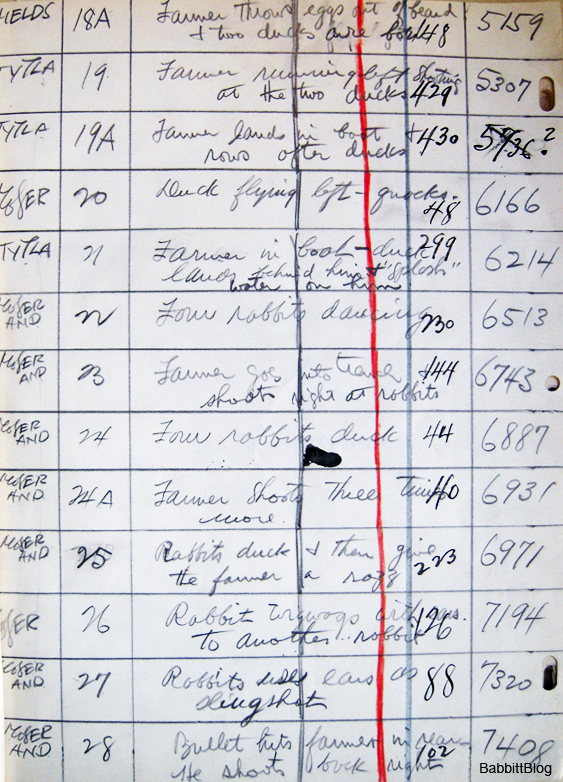
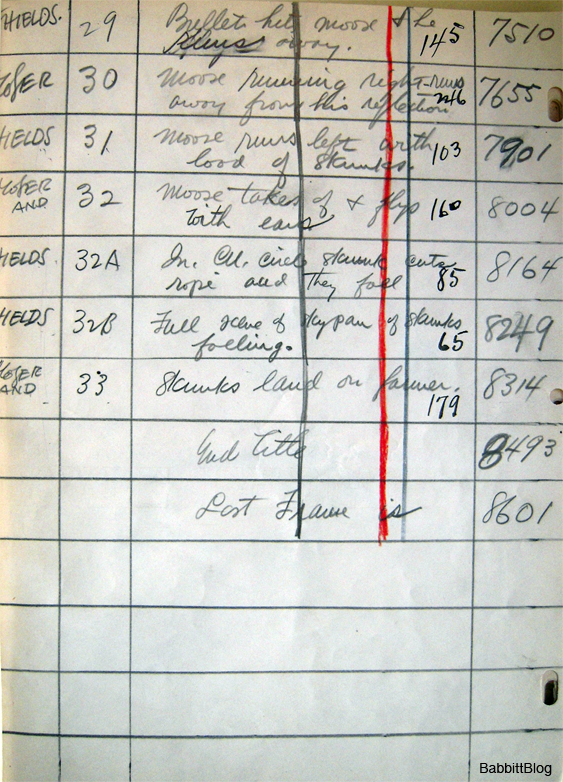
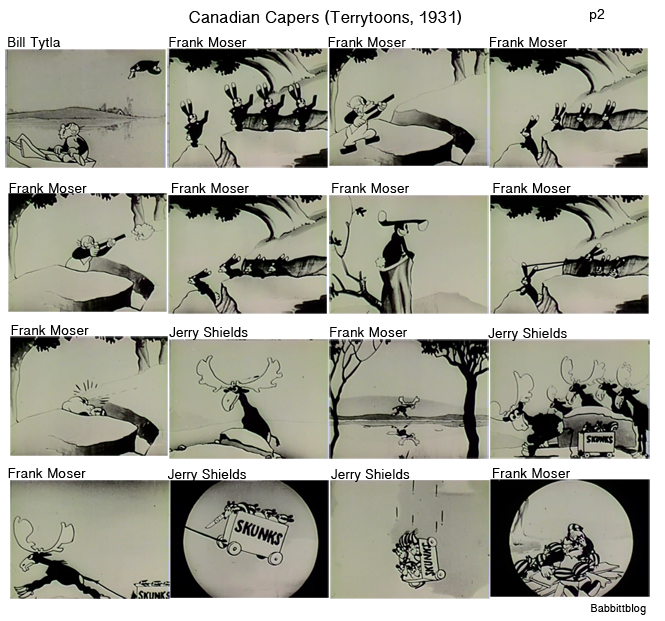
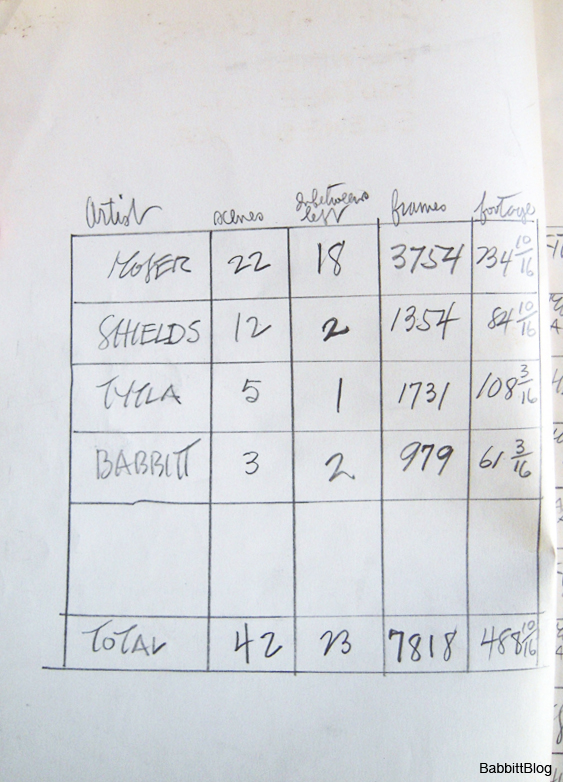
“Canadian Capers” was produced by Terrytoons and released on August 23, 1931.  Uniquely, this was assigned to only four animators:  Frank Moser, Jerry Shields, Bill Tytla and Art Babbitt. (UPDATE: Scroll Below for scene-by-scene mosaic)

CC_05 CC_01 CC_02 CC_03 CC_04

Frank_Moser_TerrytoonsFrank Moser was the man in charge of all the animation, and was Paul Terry’s business partner.  He was also the supervising animator at the studio.  “Moser always bragged about the fact that he was the fastest animator in the business,” said Babbitt, “so I told him very un-diplomatically, that’s like being the fastest violinist in the world: he can’t play worth a damn but he can sure play fast.” [1]

Jerry_Shields_TerrytoonsHugh “Jerry” Shields had been an animator for Paul Terry for years, ever since Terry directed the “Aesop’s Fables” shorts for Van Beuren Studios in the late 1920s.  Shields was a loyal employee, but had an incredibly old-fashioned animation style.  His “animation was very crude but everything he did was funny,” said Terry.  “And he was an old-timer.  He was with me until he passed away.” [2]

Tytla_TerrytoonsBill Tytla returned from prolonged art study in Europe on December 17th, 1930, and went right back to being the studio’s young star.  “Bill Tytla, he was a very fine animator, and he could render anything that you gave him (to render) very well,” said Terry.  “But he didn’t seem to have the starting quality.  If he was left by himself […] he was lost until somebody laid it out pretty well, and he would embellish it and do it very well.”[2]

ArtBabbitt_Terrytoons “We worked in this room with a very tall ceiling,” said Babbitt.  “We would take sharp thumbtacks, and pierce a piece of cardboard, then you’d lay it on top of a silver dollar and you could toss it 40 feet – and the thumbtack and cardboard would stick in the ceiling but the dollar would come back […] And poor Terry would go out of his noggin the next morning.  He come in and see all the pieces of cardboard and thumbtacks stuck all over the ceiling, a million feet up in the air.”[3]

Canadian CapersMosaic01 CanadianCapersMosaic02

Sources:

  1. Art Babbitt interview by John Canemaker, 1975
  2. Paul Terry interview by Harvey Deneroff, 1969,
  3. Tape recording of Babbitt’s 50th anniversary dinner, 1974
Posted in 1929-1932: Terrytoons, Animation, New York | Tagged , , , , , , , , | 1 Comment

The Disney Training Program of the 1930s

HyperionNarrow2

Assembled here are some quotations from primary sources about the training program that was in place at Disney’s in the early 1930s.  (Art Babbitt was part of Sharpsteen’s trainee unit from mid-1932 to early 1933.)
BSenharpsteen01b “…There were two of us picked out by Walt to supervise small numbers of beginners.  The other man was Dave Hand.  We each had small groups of green animators, maybe ten to twelve.  By picking up the scenes ourselves from the director, we saved him a great deal of time, because we did all the coaching of these new men.  During the course of expansion, Dave Hand was made a director.  The sole burden of handling these new men fell upon my shoulders.” – Ben Sharpsteen (trainee unit supervisor, later director) [1]

Jack_Kinney_℅ MichaelBarrier“About this time the ‘unit system’ was started as a way to train embryonic animators.  The unit heads were like teachers, answering our questions and putting us back on track when we got stuck.  I was assigned to Ben Sharpsteen’s unit.  Ben had a collection of characters working for him.  Besides Roy Williams and me, there was Jack Cutting, Cy Young, Ugo D’Orsi, and many others.  We were housed in one large room.  It was a motley crew, and Ben was a hard but fair taskmaster.  He insisted on good draftsmanship, staging, and action analysis.  You had to learn – no shortcuts, just do it right.” – Jack Kinney (animator, later storyman and shorts director ) [2]

BSenharpsteen01b“In the process of training new talent, there was such an influx of new applicants that a system had to be evolved to properly supervise their operation.  There were assistants of various degrees helping animators, but to make animators of them was perhaps putting too great a burden on the director of the picture.  The director of a picture had all he could do to carry out and execute the picture as delivered to him by the story department.” – Ben Sharpsteen [1]

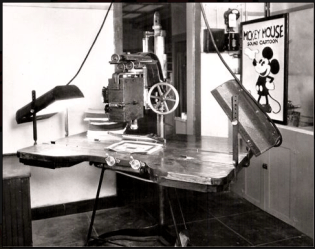
JackCutting“In the early days, if you were an animator’s assistant, doing inbetweening and so forth, after you did the inbetween drawings for a scene you had to shoot a pencil-drawing test on the old camera that is now on display on the first floor of the Animation Building, and after hand-developing the animation test and putting it on a revolving drum to dry, you went back to the drawing board while waiting for the film to dry.  Then after it was dry you spliced it into a loop and ran it for the animator.” – Jack Cutting (animator, later assistant director, shorts director and manager of foreign relations) [3]
Camera_℅ Hyperion2719 LesClark_at_moviola

WJackson“Ben did have a department of younger apprentices.  Ben would pick up a scene or a whole series of scenes from a director and then he would farm these out to these apprentices, and he would oversee what they did and help them learn how to be animators.  He did that for a while before he began to direct, and I guess Dave began to direct during that time.” – Wilfred Jackson (director)[1]

BSenharpsteen01b“There was no hiring hall for animators.  You could have picked out the best animators in other studios and plunked them in Disney’s, which happened time and time again, and they had to go through a very humble indoctrination: learning how to animate the way we did, learning how to pick your work apart, learning how to diagnose, learning to cooperate with others, learning to accept criticism without getting your feelings hurt, and all those things.  We had a saying, ‘Look, this is Disney Democracy:  your business is everybody’s business and everybody’s business is your business.’  If you did not have that attitude, you were not going to stay very long. – Ben Sharpsteen [1]

hand-david-240x240“The only difficulty in ‘adjusting’ to to the Disney approach was that there was no acceptance of slipshod animation (as there had been in New York) and no thought of cost relative to quantity.” – Dave Hand (trainee unit supervisor, later director) [4]

.

BSenharpsteen01b“… Naturally when I was given young men of doubtful abilities to use in the performance of my duties, that he [Disney]  thrust upon me, I did not realize that the man had a plan far beyond that of training men for the organization.  Diagnosing that I was particularly adept at handling green people sparked him into realizing that there was a place for me in his organization where he could profit form that.” – Ben Sharpsteen [1]

Jack_Kinney_℅ MichaelBarrier“Times were tough, and sometimes you had to suffer to get what was coming to you.  Ed Smith, another one of us who worked under Ben Sharpsteen, really did it the hard way.  He was living on turnips and bruised fruit – and one day he passed out from malnutrition.  He toppled right out of his chair, and Ben came in and found him on the floor.  Later, Ben told Walt that he thought the guys going through the ‘tryout period’ should get eighteen dollars a week.  Then they could eat at a popular greasy spoon across the street, like everybody else.  Walt agreed.” – Jack Kinney [2]

BSenharpsteen01b“While I was handling out work to the beginning animators and Walt was probably giving me a couple of more men, he took the occasion to say, ‘You know, I don’t think that you need to feel you have to do any more animation.’  Of course I thought that if I was not going to animate, then was I worth keeping on the payroll?  He could read my expression and he said, ‘You can be just as valuable as that as at animation…'” – Ben Sharpsteen [1]

“[Paul Hopkins] got Walt on statistics, and Walt was trying to achieve an organization that would keep track of what people did and he was trying to get efficiency into the workings of the Studio in spite of the way he worked himself.  So the first thing I knew, Paul Hopkins was coming in and asking me questions that I knew he got right from Walt, and it wasn’t long after that I got called to Walt’s office and here was Paul Hopkins and George Drake.  My feelings were kind of bruised, but they shouldn’t have been.  […] I had been the prime mover of that training program – the art school and all.  Walt said bluntly, ‘I don’t want you in that any more.  You have plenty to do without that.’ […] I preached the doctrine to those boys; you either learn how to draw or you’ve got no place to go in here.  ‘If you want to make a career out of this,’ I said, ‘the sky’s the limit.  This man Disney – no telling how far he’s going to go.'” – Ben Sharpsteen [5]

Sources:

  1. Working with Walt, by Don Peri
  2. Walt Disney and Assorted Other Characters, by Jack Kinney
  3. Walt’s People Volume 9, by Didier Ghez
  4. Working with Disney, by Don Peri
  5. Walt’s People Volume 3, by Didier Ghez

Photos courtesy of Michael Barrier.com, Disney.Go.com and 2719 Hyperion.

Posted in 1932-1941: Disney Glory Days, Disney, Mickey Mouse, Nine Old Men | Tagged , , , , , , , , , | 1 Comment

The Third Disney Task

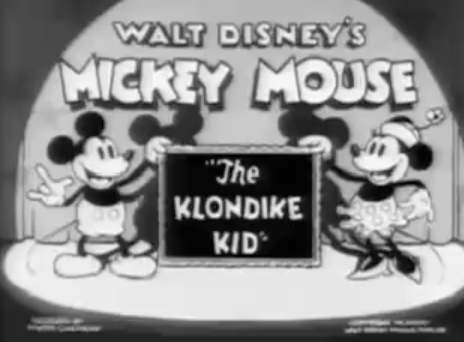
Art_Babbitt_AnimatingBy early August, 1932, Babbitt had successfully proven himself among the ranks of the novice animation talent.  Ben Sharpsteen was probably impressed with Babbitt’s Pluto work on the previous assignment, so he gave him a few more Pluto scenes in the new Mickey Mouse cartoon directed by Wilfred Jackson, “The Klondike Kid.”

Many strong animators were assigned to this cartoon.  Young men like Les Clark, Hardie Gramatky, Tom Palmer, Johnny Cannon, Frenchy de Tremaudan, Gerry Geronomi and Norm Ferguson didn’t need any supervising.  With a seasoned staff like these guys (who had been at the studio up to three years already), it was a safe bet to assign some of the weaker scenes to the newer trainees under Ben Sharpsteen.

TitleCardKlondikeKidBabbitt must have been fast-tracked into this group after having proved himself with the previous tests, because most of the other trainee artists had been there for some time already.  Here are the trainees on “Klondike Kid,” in order of who had been there the longest (with film release dates of their earliest known work).

.

“And this was about vacation time for the studio staff, but I hadn’t earned my vacation. And the end result of it all was that I ended up doing most of the picture because everybody else was on vacation. And that’s how I got started.”
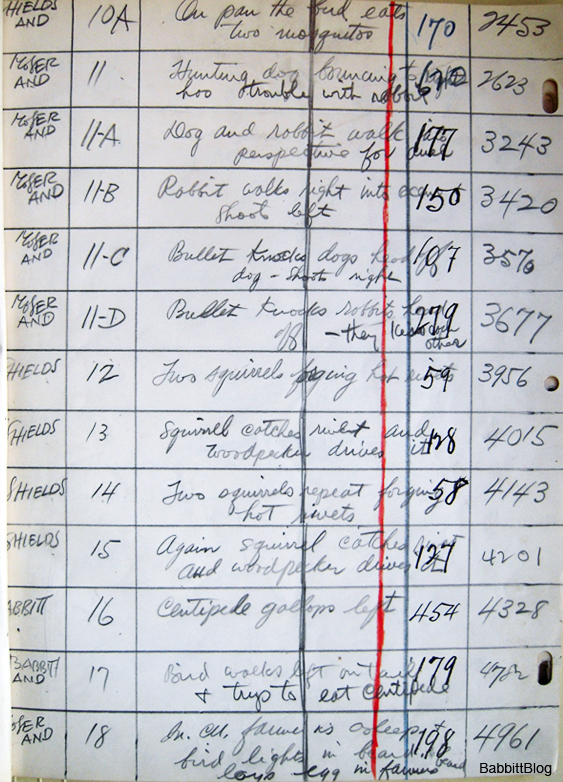
Babbitt ended up animating a hefty ten scenes of the total sixty-six scenes in the film, or 72 feet and 8 frames (48.3 seconds) of the total 580-foot (6 minutes, 26 second-long) cartoon.  He out-produced every other animator on the film.  Still, he had not yet developed as an artist.  “Most of the guys surrounding me at Disney’s were not any worse or any better than I was at that time.”
BabbittKlondike

The Klondike Kid was released 11/12/32.

[sources are Babbitt’s interview with Bill Hurtz and Disney workdrafts.  Special thanks to Hans Perk‘s terrific blog.]

<!–

Posted in 1932-1941: Disney Glory Days, Animation, California, Disney, Film, Hollywood, Mickey Mouse, Nine Old Men | Tagged , , , , , , , , , , , , , , , , , , , , , , , | Leave a comment

The Second Disney Task

BabbittDrawingAfter Babbitt completed his first inbetweening test, news of his speed spread across the studio “like wildfire.”  Cartoons were, by their nature, expensive to make, requiring more time to produce six minutes of footage than a live action film required.  In an industry where every frame or two is laboriously drawn, an artist who can work fast is highly prized.  Within hours, word reached the desk of lead animator Ben Sharpsteen.

Ben Sharpsteen

Ben Sharpsteen

Sharpsteen was raised in California and had animated in New York in the days before soundtracks.  He came to Disney’s in 1929 at the age of 33 with an analytic eye (he would soon be a recruiter) and a craft for art and storytelling (he would soon be a director).  He had a quiet and subdued demeanor, and the animators felt he was overlooked for a directing job because of this.  If it phased him, Sharpsteen didn’t let it show.  He was assigned the task to mentor the junior animators in the fold, and he was a “hard but fair taskmaster.  He insisted on good draftsmanship, staging and action analysis.  You had to learn – no shortcuts, just do it right.”  If Babbitt  passed the next test, Sharpsteen would become his supervisor.

There were many novices at Disney starting out at that time.  The studio had the daunting task to train the newbies, and simultaneously produce animation quickly.  The directors Burt Gillett and Wilfred Jackson had their hands full, so Sharpsteen, and fellow supervisor Dave Hand, were elected to distribute bulk of scenes to the novices as they saw fit.

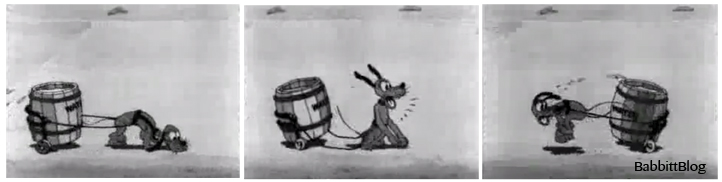
Touchdownmickey02On his desk, Sharpsteen had some folders of drawings for the latest short that Jackson was directing, Touchdown Mickey.  He picked up a short Pluto scene: Pluto walks and sniffs to the right, sees the mob and runs to the left.  The extreme poses were already done, but it needed the inbetweens.  Could this new Babbitt fellow animate a four-legged walk cycle, a jump and a four-legged run, and convincingly stick to the pup’s change in emotions?

Pluto_Touchdown_Mickey

Babbitt nailed it, and Sharpsteen was pleased.  Now he was in the pool of young animators that would finally get scenes of their own – as long as they were supervised by Sharpsteen.

.

[sources are Working with Walt by Don Peri, Walt Disney and Other Assorted Characters by Jack Kinney, and interview transcripts by John Canemaker and Michael Barrier]

Posted in 1932-1941: Disney Glory Days, Animation, Disney, Mickey Mouse | Tagged , , , , , , , , | 1 Comment

The First Disney Task

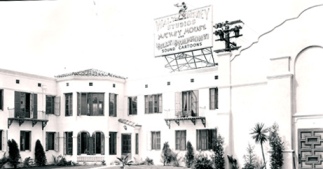
HyperionSignWhen Art finally got hired at Disney Studios in July 1932, he, like countless others before and after him, was assigned to inbetween another animator’s drawings.

Inbetweening is low on the animation rung, but luckily for Art, the studio had not yet ramped up its staff.  Whereas now an artist could spend years unbetweening before a better position opens up, Art simply had to prove himself competent.  Plus, there was no formal training ground.  Everyone was expected to be able to make drawings move, but to actually imbue it with charm and “the illusion of life,” well, that had yet to be established and defined.

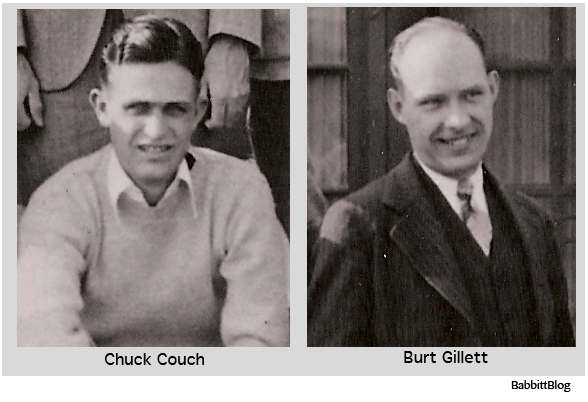
Art was assigned as inbetweener to animator Charles “Chuck” Couch.  Couch measured an insecure 5’8″ and was just 23 years old.  He generally worked fast and broad on comic scenes, but wasn’t considered especially versatile.  His company review describes him as being “inclined towards griping.  Is not too dependable on getting a good result.  Very inconsistent.”

Chuck_Couch_Burt_Gillett.The short was “King Neptune” and it was being directed by Burt Gillett.  Gillett supervised the animation and ordered retakes from the animators, but didn’t do any actual drawing.  When his mouth wasn’t stuffed with hard candy or the liquid contents of tiny alcohol bottles that he kept in his drawer, he would speak “with machine-gun rapidity, then there would be a sudden stoppage, not always where one expected a natural pause.  Then it would suddenly resume at breakneck speed.”  He was a talented, if showboating, director.

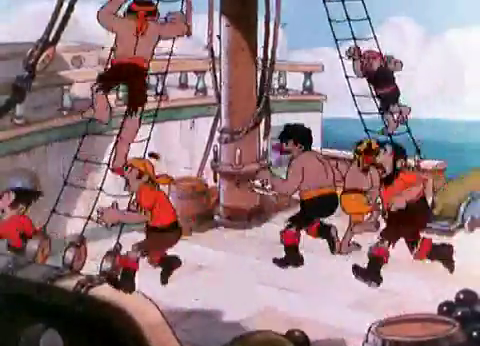
KingNeptuneArt was assigned to inbetween a short shot in which a crowd of pirates scurry up the galleon’s mast.  For new hires, such a job  would have taken a week to get it right.  However Art not only had previous experience inbetweening, he had actually been a chief animator over at Terrytoons for the past three years.  He blew right through the scene.  With the stack of completed drawings in his hands, he approached Couch late the next day.  Couch asked him if he had a questions about the scene.  Art replied that he didn’t have a question; he was done.  Couch was incredulous, but tested the scene on the moviola and discovered, to his shock, that it worked beautifully.

[sources are Shamus Culhane, Disney company records and interviews by Michael Barrier and John Canemaker.]

Posted in 1932-1941: Disney Glory Days, Animation, Disney, Film, Hollywood, miscellaneous, music, Photography | Tagged , , , , , , , , | 2 Comments