The Snow White Wrap Party – part 1

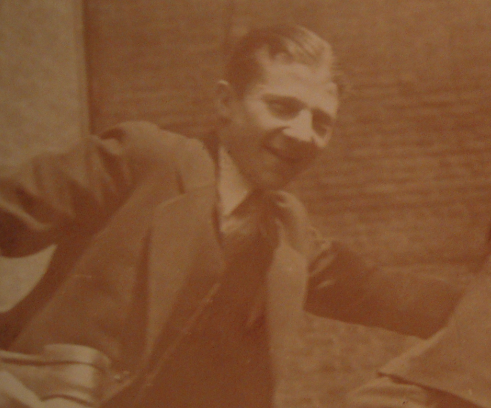
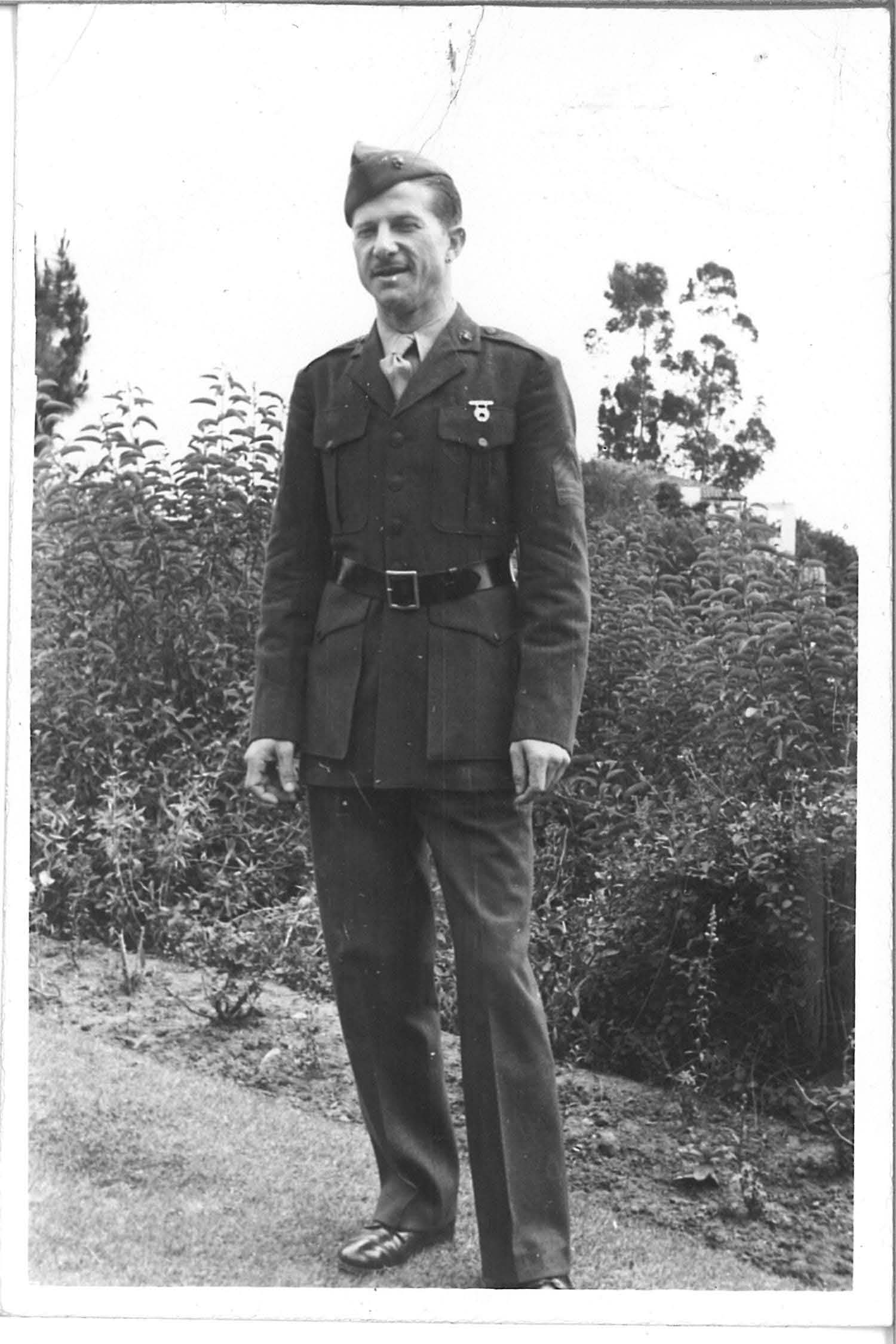
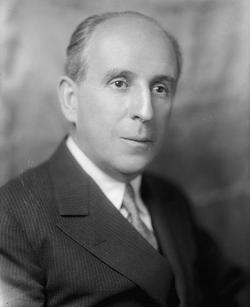
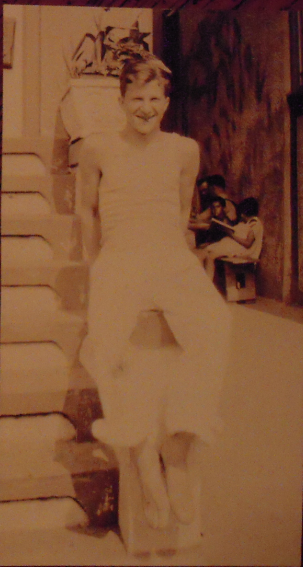
Art Babbitt circa 1938, age 30

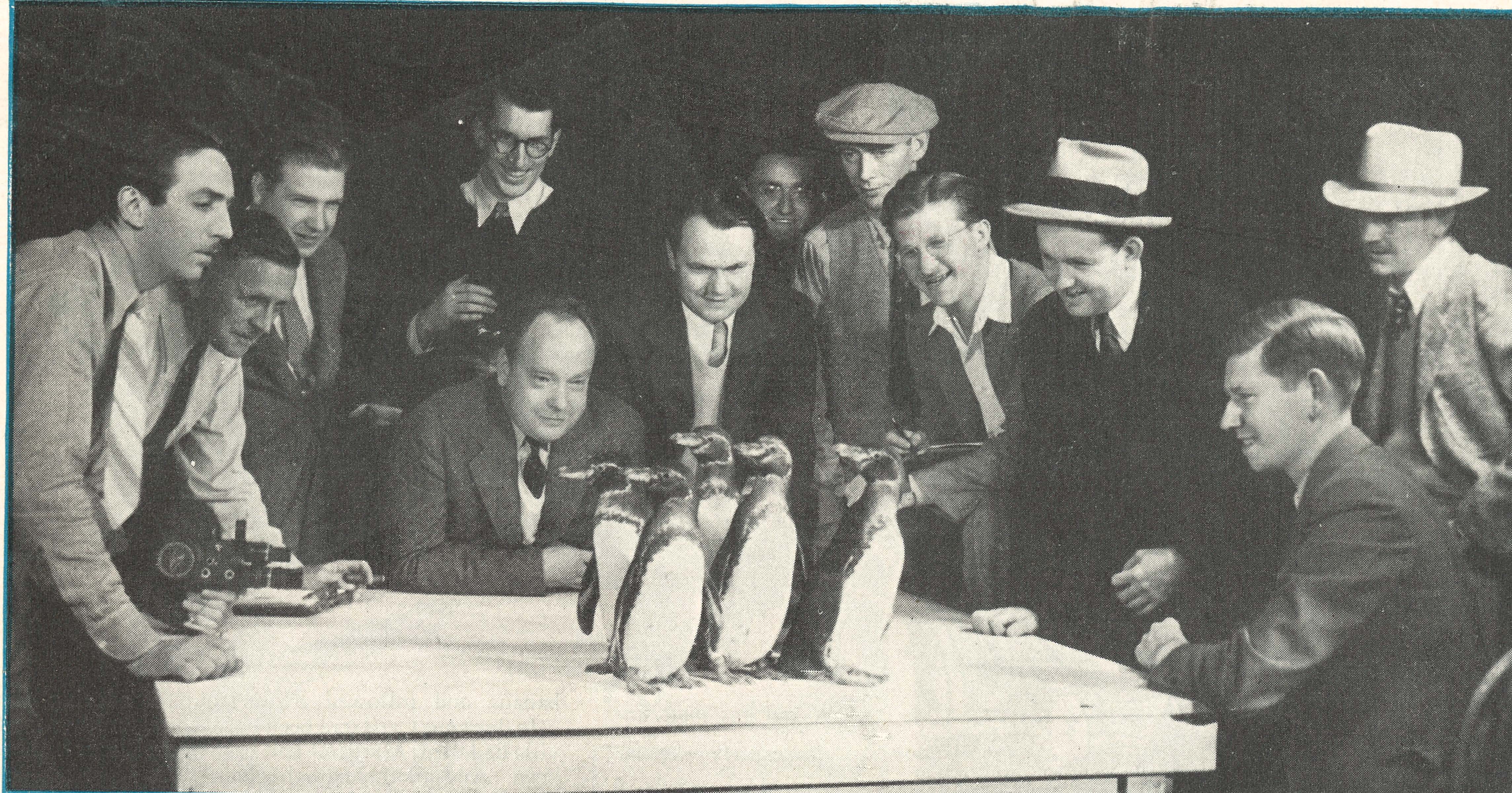
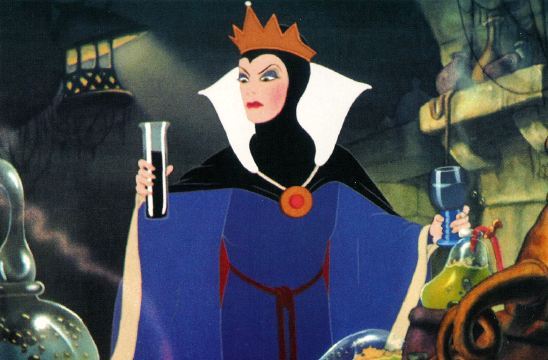
On the weekend of June 4, 1938, Walt rewarded his hard-working staff with a 2-day party at the Lake Narconian resort hotel near Palm Springs.  It was a thank-you to the overworked artists (their families were invited, too), who had worked scads of unpaid overtime to turn out this milestone of a film before Christmas, 1937.  Incidentally, Art Babbitt’s main contribution to the film was lead animation for the evil Queen.

Reports differ as to what went on at this party – from nothing more than prohibition-era drinking to full-blown open sex.  Either way, Walt was upset by the actions of his “boys” and, with his wife Lillian, left the retreat early.

These photos are care of my friend, Willie (Willis) Pyle.  Willie started at Disney’s in late 1937 as a “traffic boy.”  This meant that he, along with other young entries, was a human modem.  When someone needed to send a letter or have test animation developed and returned, or what have you, a traffic boy would be called to do the job.  But that’s a story for another day.
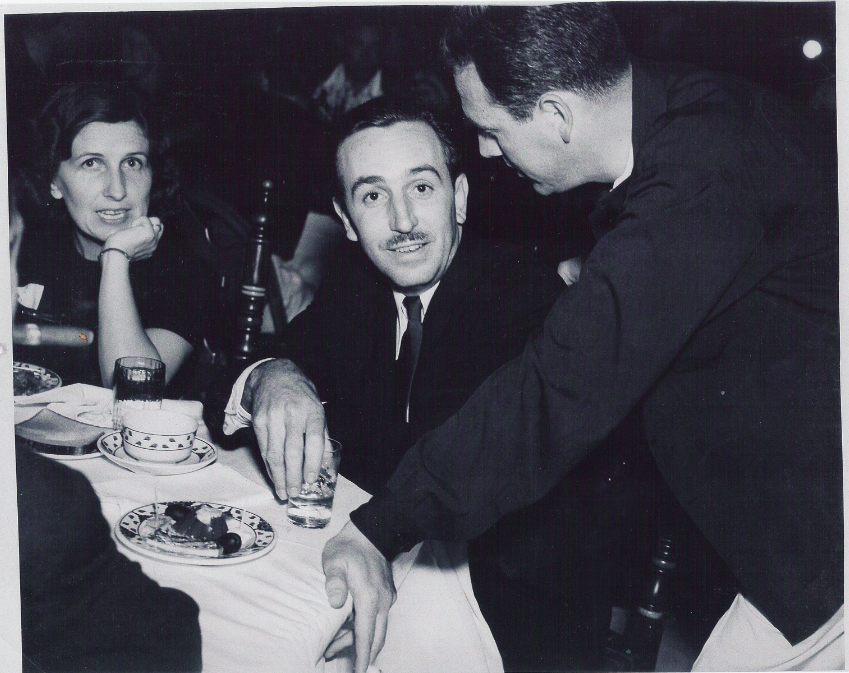
Walt, with wife Lillian and Snow White director Dave Hand

“Now I must tell you that we framed Walt Disney,” said Art Babbitt in the 1987 documentary Animating Art.  “He was seated at a table with friends and family, and I made an arrangement with the policeman on duty there; without Walt’s knowledge, I told the policeman to go over there and tell him to quite down, that he was making too much noise, and Walt’s reaction was, ‘I’ll have your badge,’ […]  and of course then, it was finally revealed that it was all a joke, you know.”
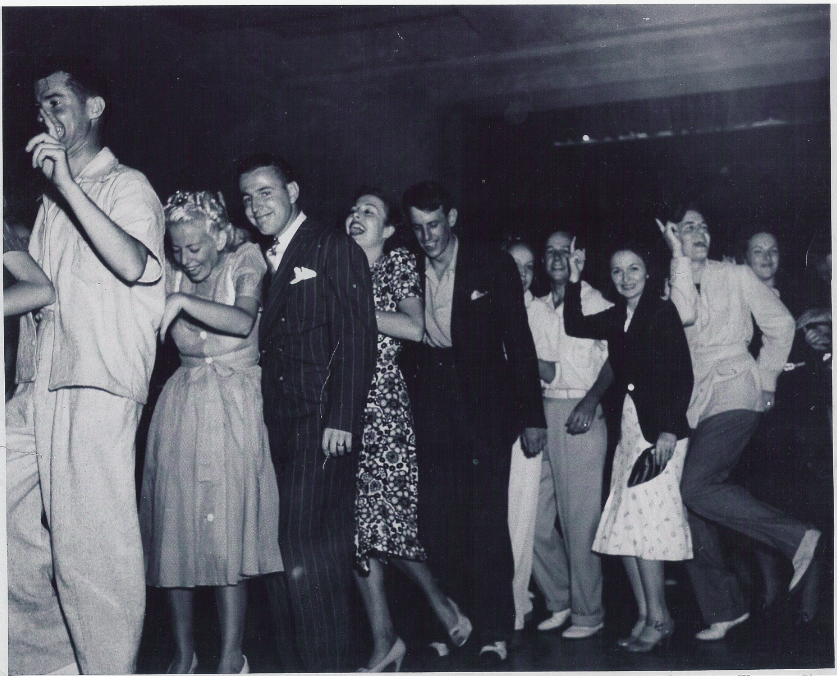
The woman center in the flowered dress is Marge Belcher (now Marge Champion), the model for Snow White.  She was a teenage dancer, and when the animators needed someone to film to inspire the movements of the princess Snow White, they hired her.  At the time of this photo, she and Art Babbitt had already been married ten months.  Directly behind her is Willie Pyle.  Willie’s long-term memory is remarkable sharp.  He told me, “this dance we all did, it was called ‘The Big Apple.'”  Sure enough, on one of Art Babbitt’s many hand-scrawled notes, I found a reference to a dance called “The Big Apple,” … and that Marge had taught it to everyone.
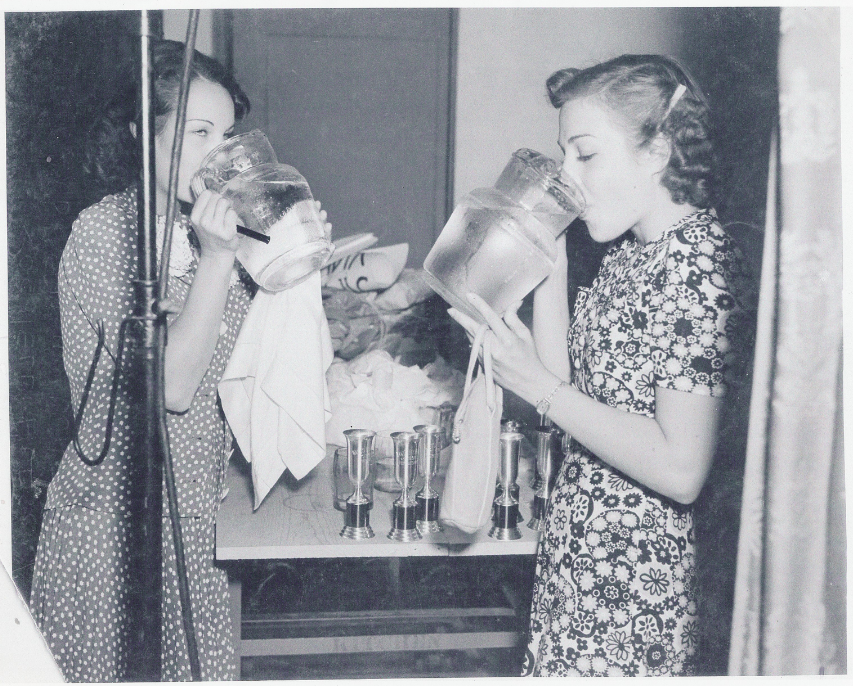
All that dancing works up a thirst for ice-water, as Marge, on the right, is demonstrating.  The objects behind her are described in Jack Kinney’s memoir, Walt Disney and Other Assorted Characters: “The event was very well organized by Hal Adelquist and his helpers, who arranged many activities for all to enjoy – swimming, horseshoes, baseball, volleyball, touch football, aquaplaning, Ping-Pong, and, of course, boozin’!  Handsome cups, inscribed ‘Walt’s Field Day,’ were awarded to the winners of these various events except for boozin’, and there were just too many competitors in that last event to declare a winner.”

Stay tuned for Part II of the Snow White Wrap Party!
Posted in 1932-1941: Disney Glory Days | Tagged , , , , , , , , , , , | 3 Comments

Art Babbitt’s New York

Art Babbitt New York

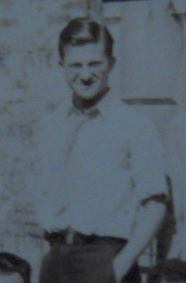
Art Babbitt circa 1924, age 16

Art Babbitt (neé Babitsky) and his family moved from Sioux City, Iowa to New York City in 1924, at the age of 16.  Art left for the Disney Studios in Hollywood in 1932, when he was 24.

Not only is that a hell of a time to be in New York, that’s a hell of an age to be in that New York!

People don’t grow in a vacuum.  Everyone is somehow influenced by their world around them.  This midwestern kid, Born in Omaha and raised in Sioux City, was suddenly entrenched by the Jazz Age!  — F. Scott Fitgerald’s “land of ambition and success,” the Roaring Twenties, and the first Macy’s Parade.

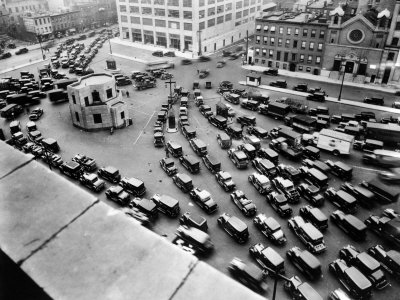
Sioux City had horses and carriages (Art’s father was horribly injured while driving one).  New York had hoards of motorists.  Stores were competing to sell you the most affordable radio.  The country had exited WWI as a superpower and economic powerhouse.

Babbitt circa 1926, age 18

In New York, everyone was talking about Wall Street.  Fortunes were being made.  Art Babbitt was working for a grocer as a stock boy.  One day he found a business card in the street for an ad agency and he applied as an artist.  Thus began his career as “a pencil pusher.”

In 1928 New York governor Al Smith ran for president against Herbert Hoover.  Smith was somewhat of a hero for the labor reform movement, pushing through legislation for social welfare and public works projects.  He was elected for four terms, and when he ran for president against Hoover, he lost.  Terribly. This was in no small part to country-wide bigotry against his Irish Catholic roots.  The KKK even burned crucifixes at the stops of his campaign.  In 1928, it was a sin to be different, to have immigrant roots.

Babbitt (right) circa 1928, age 21

By the end of 1929, the Crash brought the investors to ruin.  Art Babbitt was not an investor – with an injured father and a family of six, he couldn’t afford to be.

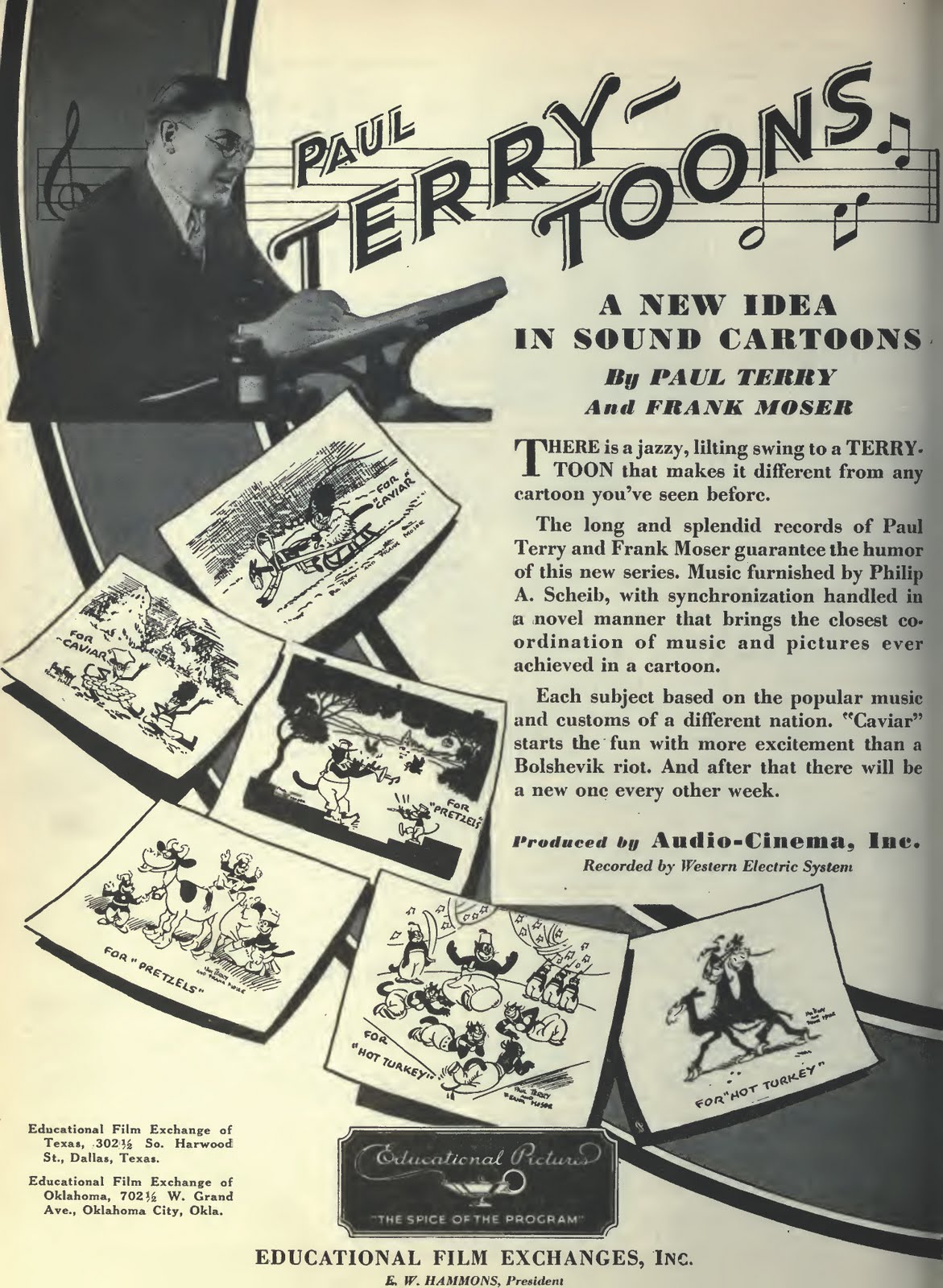
He had been running a successful independent business as an illustrator and ad man (and had done some crude animation this way) and got a job at Terrytoons months before the crash.

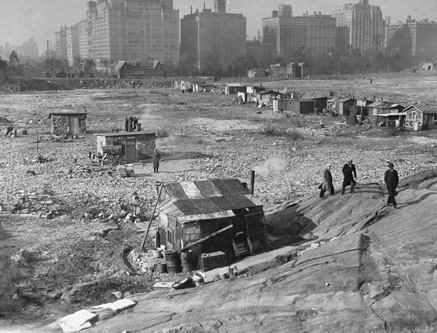
But this was the Great Depression.  Bread lines  and shantytowns were emerging, as well as one enormous oddity.

The Empire State Building was being constructed at record speed, and by 1932 the tallest building in the world sat in the middle of Manhattan.  It was dedicated live by Al Smith (filmed for newsreels and recorded and broadcasted on the radio), who had nothing to do with the construction whatsoever.  He had been assigned the “head of the project” by businessman John Jacob Raskob, the man with the ambition and the money to build this colossus.  Raskob had been Smith’s campaign manager for his crippling run for presidency and felt he owed him one.  As a result, the people of New York watched laborers risk their lives on a daily basis, while the ex-governor cut the ribbon.

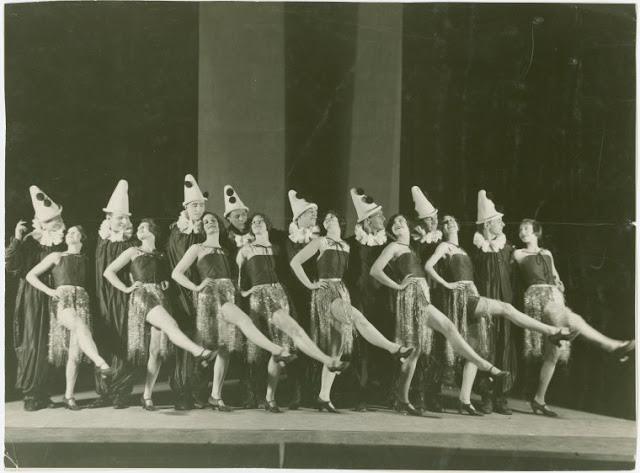
There’s much more to Art Babbitt’s New York that needs to be shared – like his personal encounters with Cab Calloway in Harlem and the Zigfreld Follies dancing girls on Broadway, not to mention xenophobic Red Scare, the politics of corrupt showman mayor Jimmy Walker, “liberal Bolshevism” criticisms of president Roosevelt, and the WWI vet Bonus Strikers.  But that will have to wait for another day.

Posted in 1924-1929: Illustrator in NYC, 1929-1932: Terrytoons | Tagged , , , , , , | 3 Comments

Art Babbitt’s Guide to Spanish

Art Babbitt 1941

Art Babbitt in mid-1941

In January 1942, Art Babbitt went on a solo voyage to South America, probably to clear his head.

It was on the heels of the famed Disney Strike.  Art just vilified his boss in front of a global audience.  It was Law vs. Public Opinion, and Art Babbitt sided with legality.

With the strike settled but his law suits not (more on this later), Art drove from Hollywood to New York, and from there took a ship to South America.  He spent nearly three months there, keeping a daily diary that shows his highs of travel and his lows of anxious doubt.  What’s more, Art took this trip mere months after Walt took his South America good-neighbor tour, and encountered some of the same people Walt did.

More diary stuff will be to come, but I thought I would whet your appetite with an entry detailing Art’s wit as he attempts to grasp a foreign language.  (Scroll to the bottom to read a more legible transcription)

March 26, 1942

[…] he’d cut a slit in the crotch of the girdle. The girl was of course terribly surprised when he gained entry.

I’ve been thinking of my Spanish that I’m rapidly forgetting and how I’d learn words by association – for example:

“Gustar” means “to enjoy” and “gastar” is “to spend.” I say to myself that in order to “gustar” one must “gastar”.

“Apenas” means “hardly”.  I think of “hard” which recalls “penis” and there I have it.

“Rincon” means corner – so I think of Billy Sundaya revival meetings and our profane version of “Brighten the Corner Where you are.” We sang it “Right in the corner – where you are”.

“Consado” means “tired” and “cassado” means “married” — the connection is obvious.

“Acostarsé” means “to go to bed” – the connection is somewhat remote but I think of “accost” – and what follows may be “acostarse”.

I don’t indulge in dirty jokes so I get my vicarious pleasure by learning my Spanish vocabulary.

Posted in miscellaneous | Tagged , , , , | 2 Comments

Terrytoon Layouts

Art Babbitt in 1930

When Art Babbitt was a young man at Terrytoons in the Bronx, he worked his way up to the esteemed position of animator.  He was at the bottom of the totem pole, but at least he was animating.  This means that he’s actually deciding the way in which the characters hit their poses, and thus the way they move.  Here, at the start of his career, he’s not getting any scenes that are particularly note-worthy.  But it’s a start.

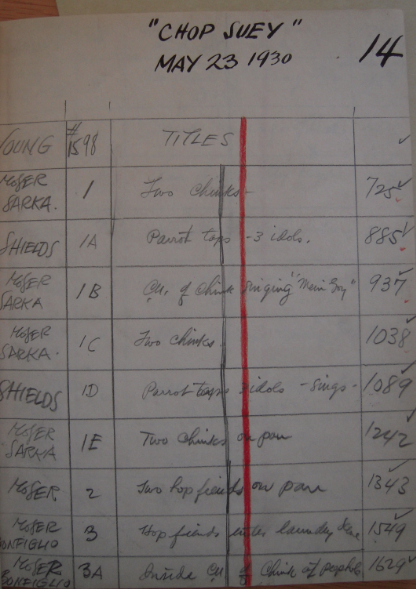
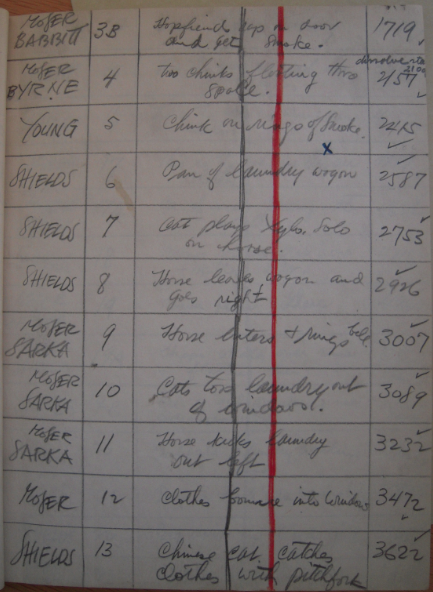
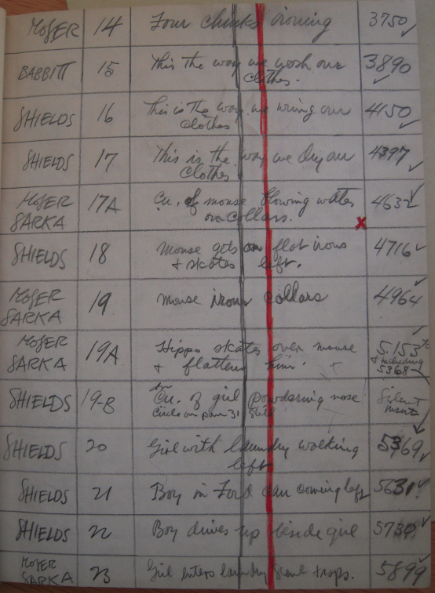
Below is a workdraft of a 1930 Terrytoon cartoon “Chop Suey.”  It’s basically a shot list.  The star animator, a middle-aged veteran named Frank Moser, has the majority of the scenes.  Art Babbitt, age 22, has a couple of his own.

.

.


Frank Moser Terrytoons

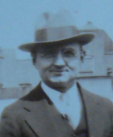
Frank Moser in 1931

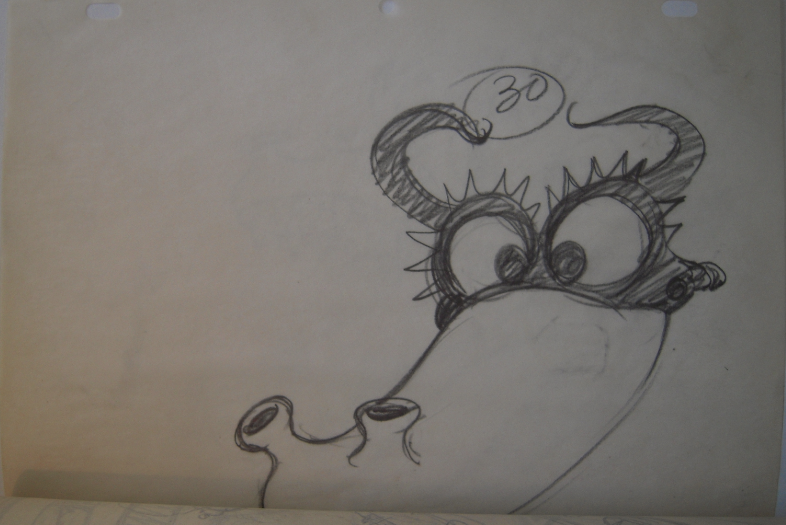
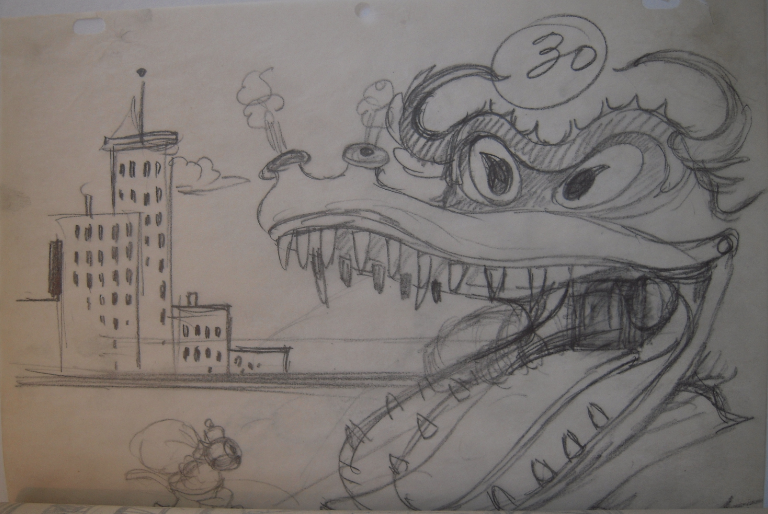
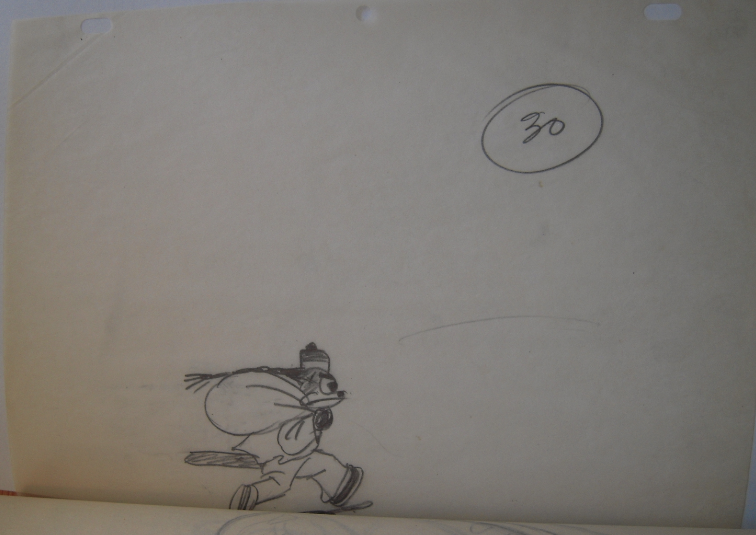
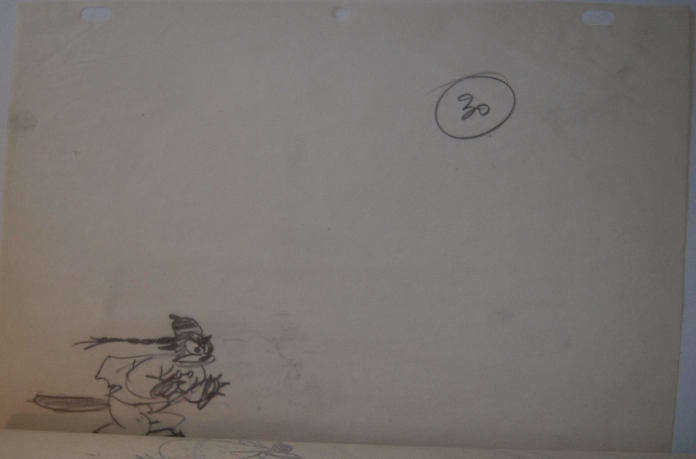
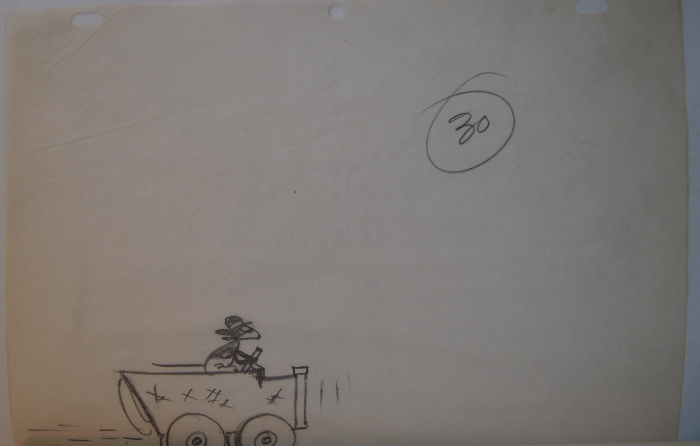
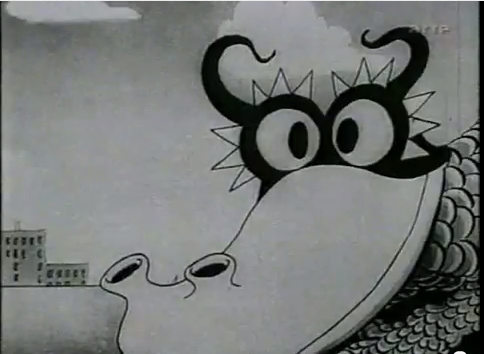
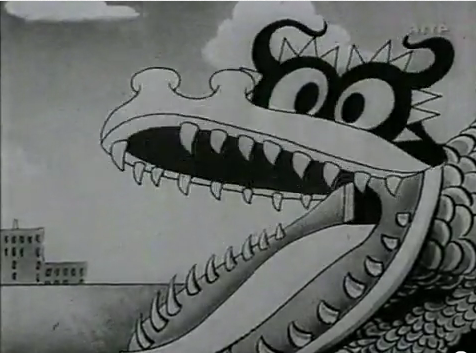
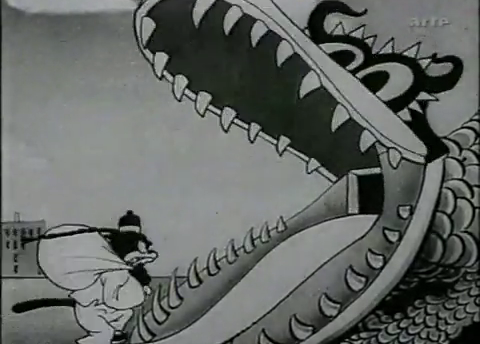
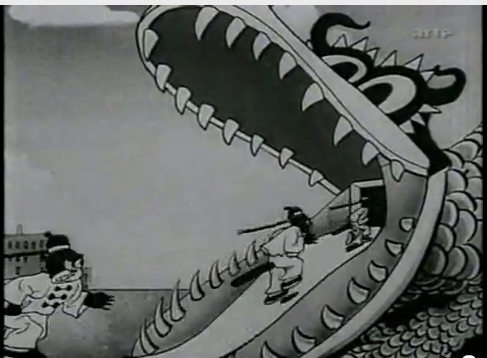
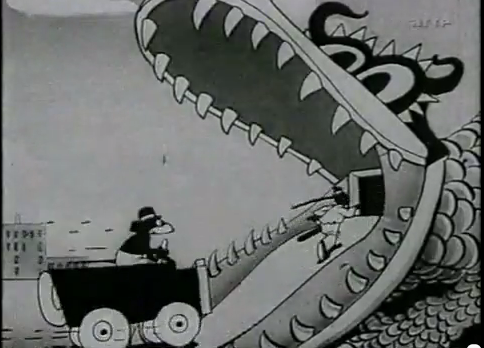
Babbitt has “Scene 30” all to himself.  In archaically racist terms, it reads, “Chinks and Boy run into dragon’s mouth.”  It was assigned to Art probably because it wasn’t considered a particularly meaty or challenging scene, and because it’s not carrying a major gag or plot point that would ruin the film if it were missed.  These films were produced at a rate of one every two weeks – an incredibly hectic schedule that left no room for trial and error.  You had one shot to do your scene so it better be good – or at least readable.

.

Jerry Shields in 1930

Art would sit at his animated desk and be handed a folder with his scene.  The folder for a scene would usually contain anywhere from 1 to 5 layout drawings.  These are drawings done on animation paper (at the time it was 8 x 10” tracing paper with special peg holes); they were probably drawn by Frank Moser (super top animator) or Jerry Shields (mini top animator).  These layout drawings would show the placement of the characters within the setting so the animator would know where to place his Cat and where to move his Mouse.  It’s sort of like being a theater actor when the director tapes a couple white X’s on the stage floor to guide your walk from stage left to stage right.  Below are the total of 5 layout drawings that describe the placement of all moving elements in  “Scene 30” of the Terrytoon short Chop Suey.


And here are screenshots of the final animation, drawn and animated by Art Babbitt:

If you want to watch the whole cartoon, you can view it here.

Posted in 1929-1932: Terrytoons | Tagged , , , , , , , | Leave a comment

Disney Paperwork: mid-30s

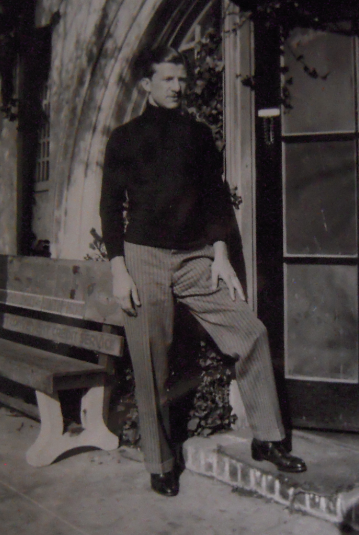
In June 1932 (close to when this picture was taken), Art Babbitt joined the Disney staff on a temporary basis.  They wanted to try him out, see if really was all he made himself out to be.  Art started out as a low-level inbetweener — that means other guys draw the main poses, and Art had to draw the motion to get from A to B.  But more on that later.


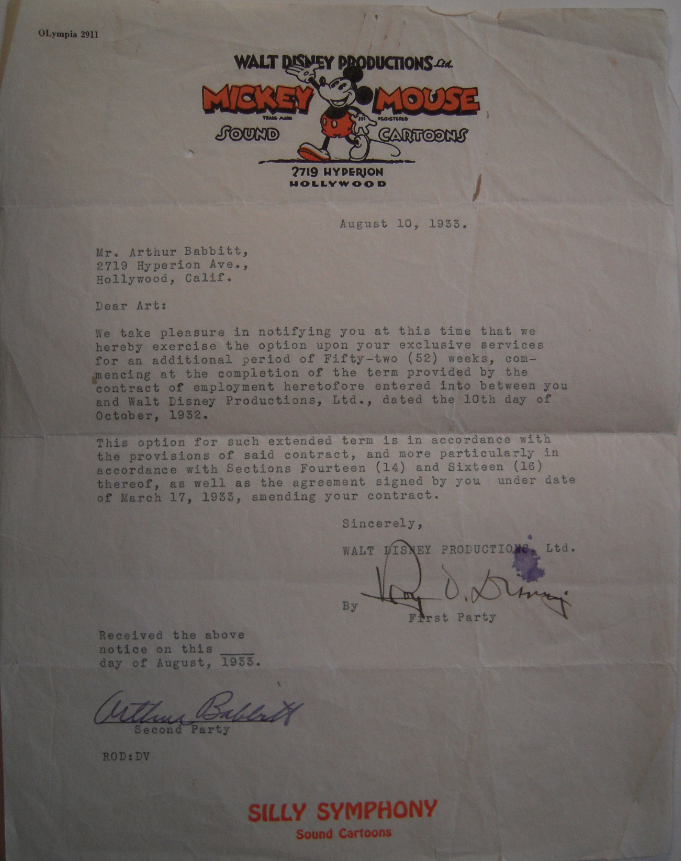
Roy Disney was Walt’s older brother.  While Walt was the creative side of this family business, Roy was the business side.  In 1934, Roy Disney signs Art Babbitt into the company with the contract below.

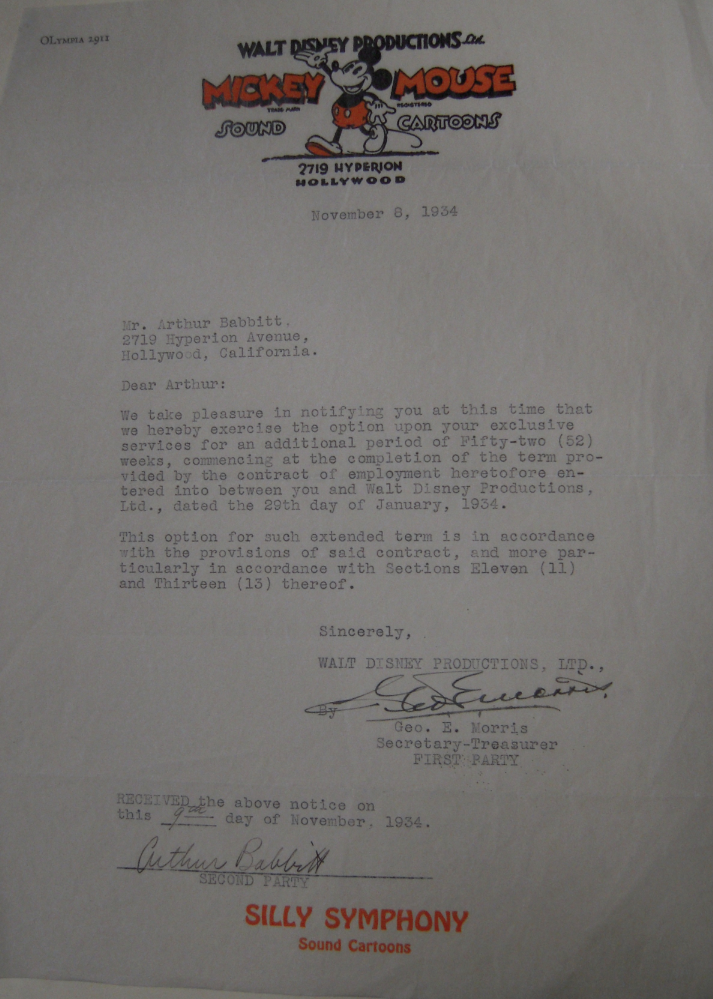
In 1934, Art’s contract is renewed.  With the growth in the company, George Morris is now handling the contracts, and Roy is working on company-wide business.

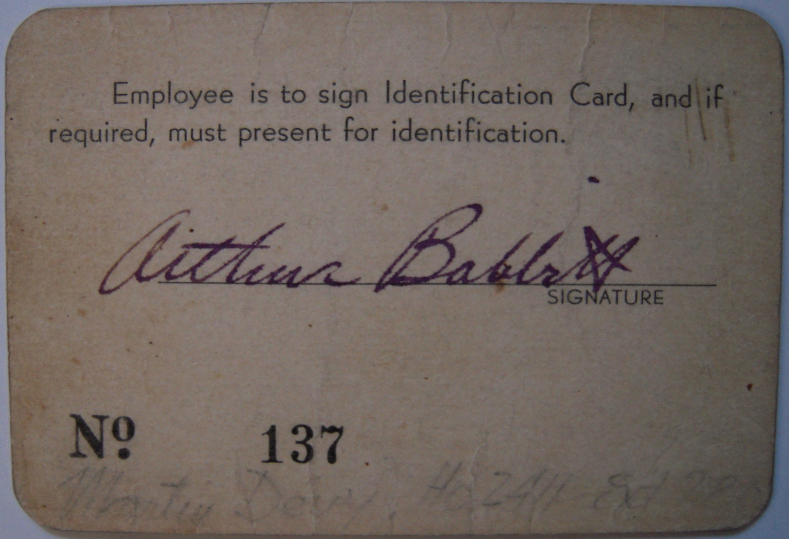
And by 1936, all employees had to have ID cards to get into the Walt Disney Productions lot on Hyperion Avenue.


Posted in 1932-1941: Disney Glory Days | Tagged , , | 1 Comment

Walt Disney Studios on Hyperion Ave


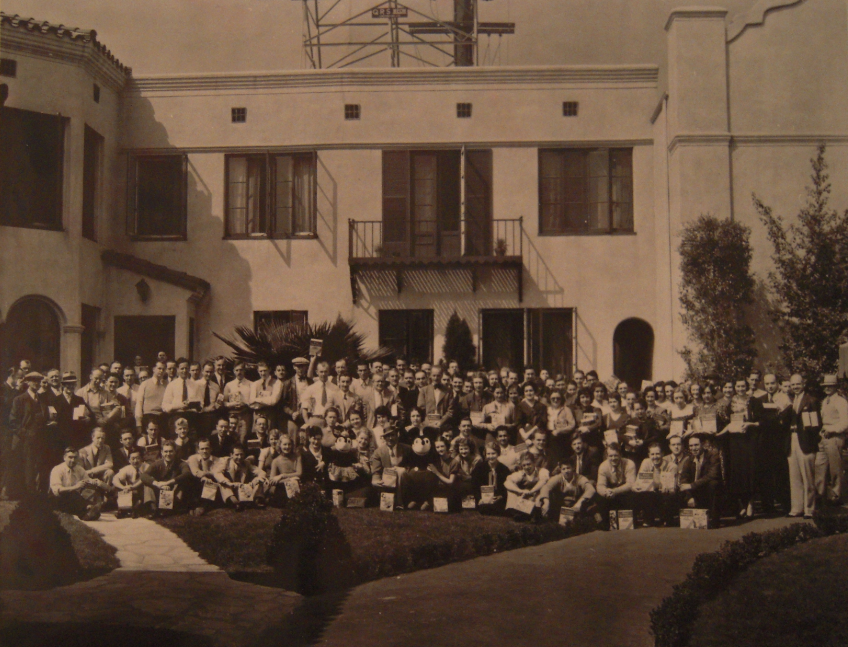
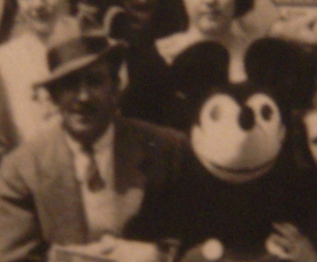
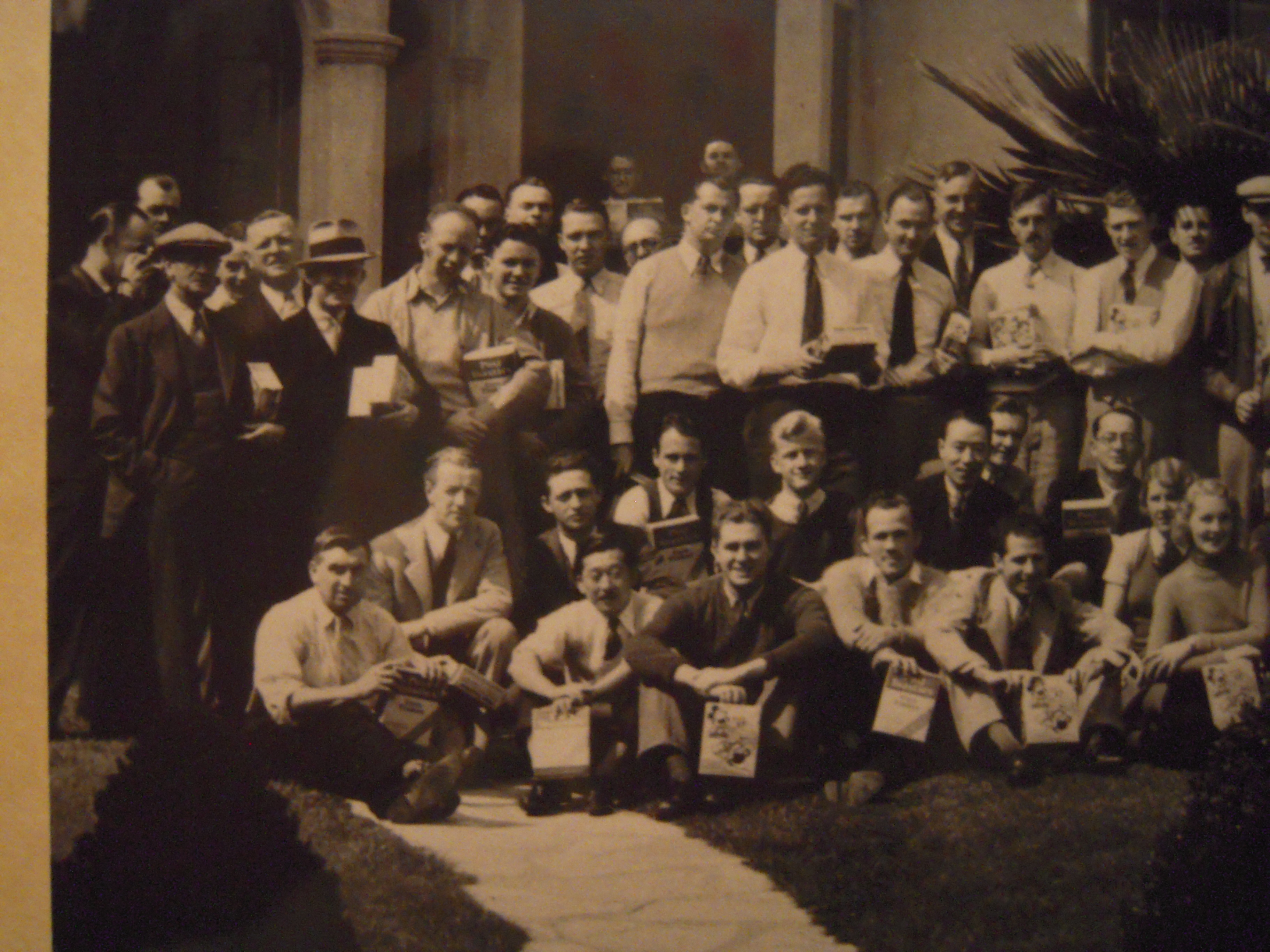
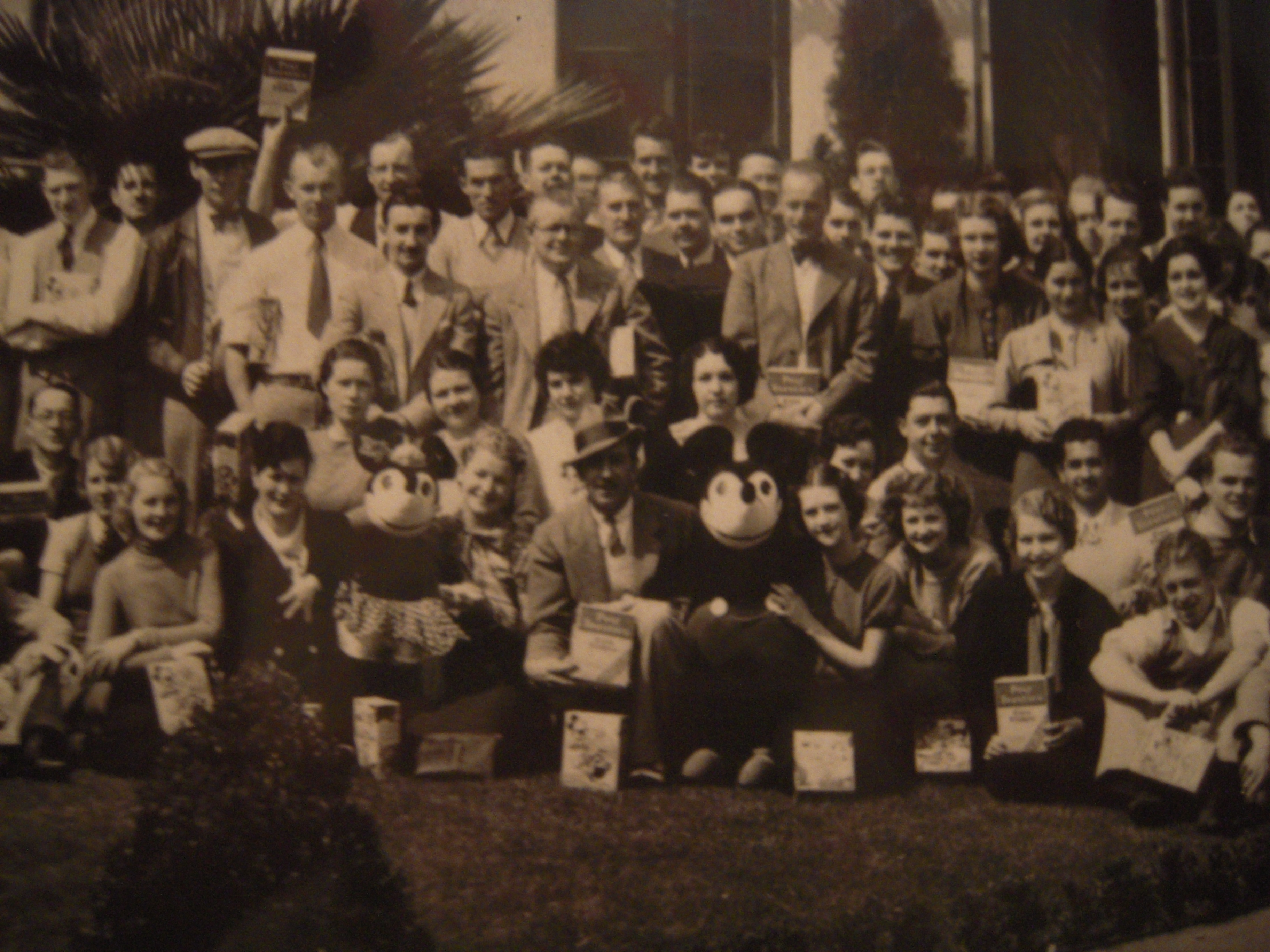
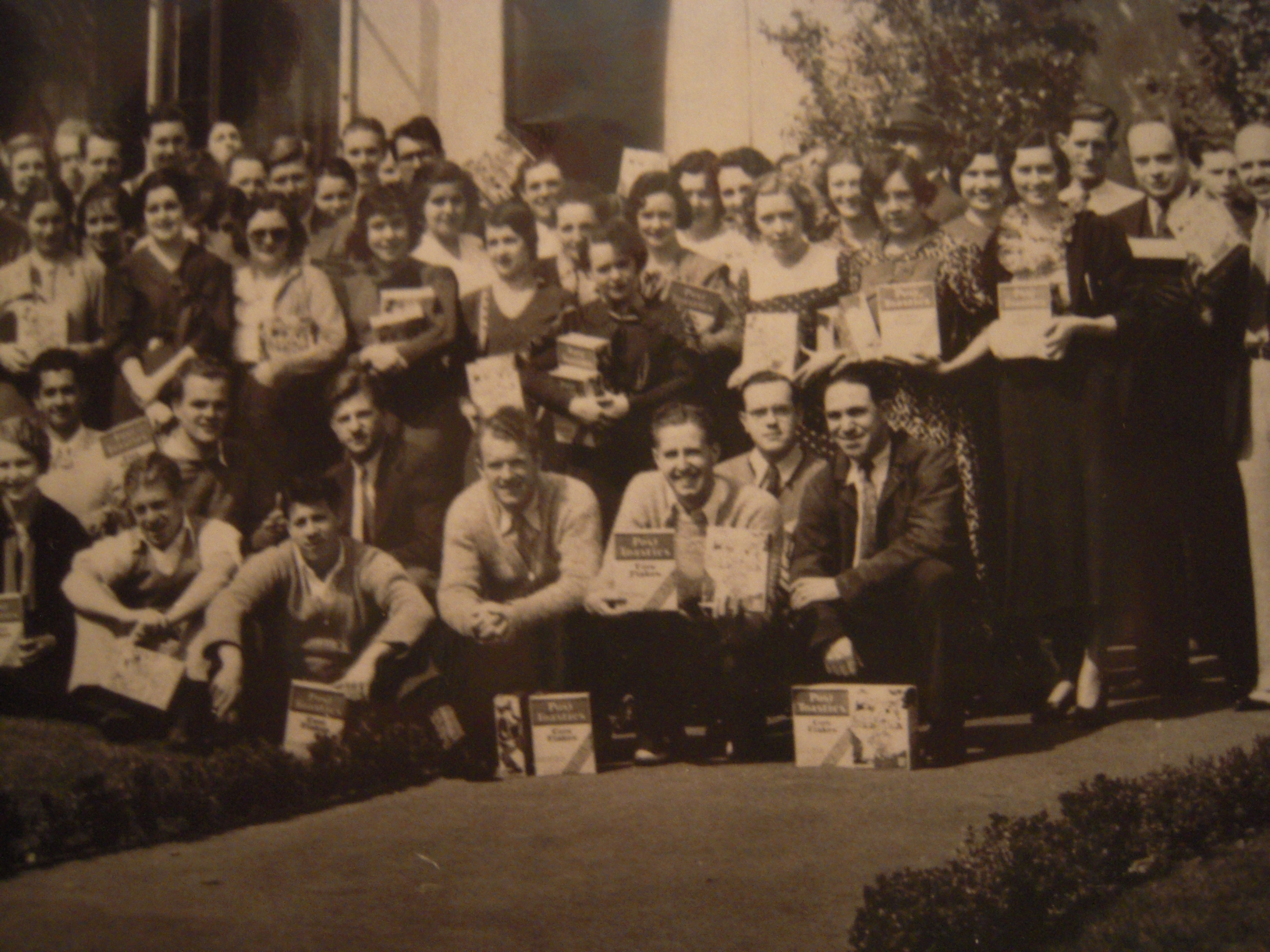
This picture of the entire Disney staff was probably taken some time in late 1933 or early 1934.  The staff is holding boxes of Post Toasties. Walt and his brother Roy had hired Herman “Kay” Kamen to merchandise the Disney brand in 1933, and soon Mickey was on wristwatches and breakfast cereals. Suddenly the Mouse went from movie star to household brand all of his own, and Walt was able to afford to make the expensive, experimental cartoons he wanted.
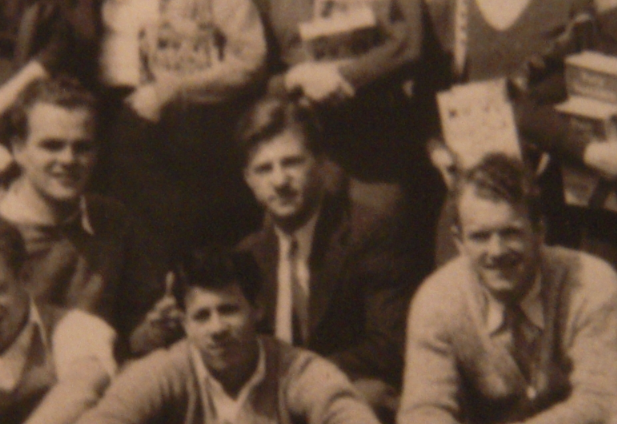
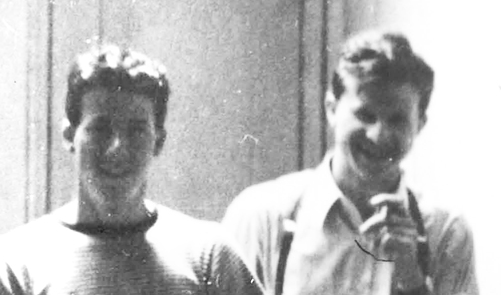
Art Babbitt is flanked by his friend, animator Hardie Gramatky on the left, and animator Johnny Cannon on the right. In front is Freddy Moore, the animator boy genius. Art shared an animation room with about 7 other guys, two of them being Hardie and Freddy. Hardie had gone to college at Chouinard art school  … but more on that later.

The above photo captures a playful moment in which Art, appearing solemn, is  flicking Freddy Moore’s ear!  The next moment Freddy probably spun around, batting furiously at Art’s hand.  Art would have played dumb and still laugh his ass off.

I love Walt’s face here. He looks like a kid in a candy store, living his dream. Everyone around him looks so enthused and excited to be there. The studio staff numbers about 110 people here – including the ladies of the ink & paint  – and it was still growing!

I’m including some slightly higher-rez images of the group shot below.  Click to enlarge.


Posted in 1932-1941: Disney Glory Days | Tagged , , , , , , | 3 Comments

Welcome to the world of…Art Babbitt!

Of all the people who have put their mark in the history of animation, nobody has affected it more significantly in as many diverse ways as Art Babbitt.

I’m Jake Friedman. Like Art, I have been an animator, a teacher and an activist.  I’m also Art Babbitt’s authorized biographer and his story, in its own way, is also a history of of animation.

Some ways in which Babbitt is already renown:

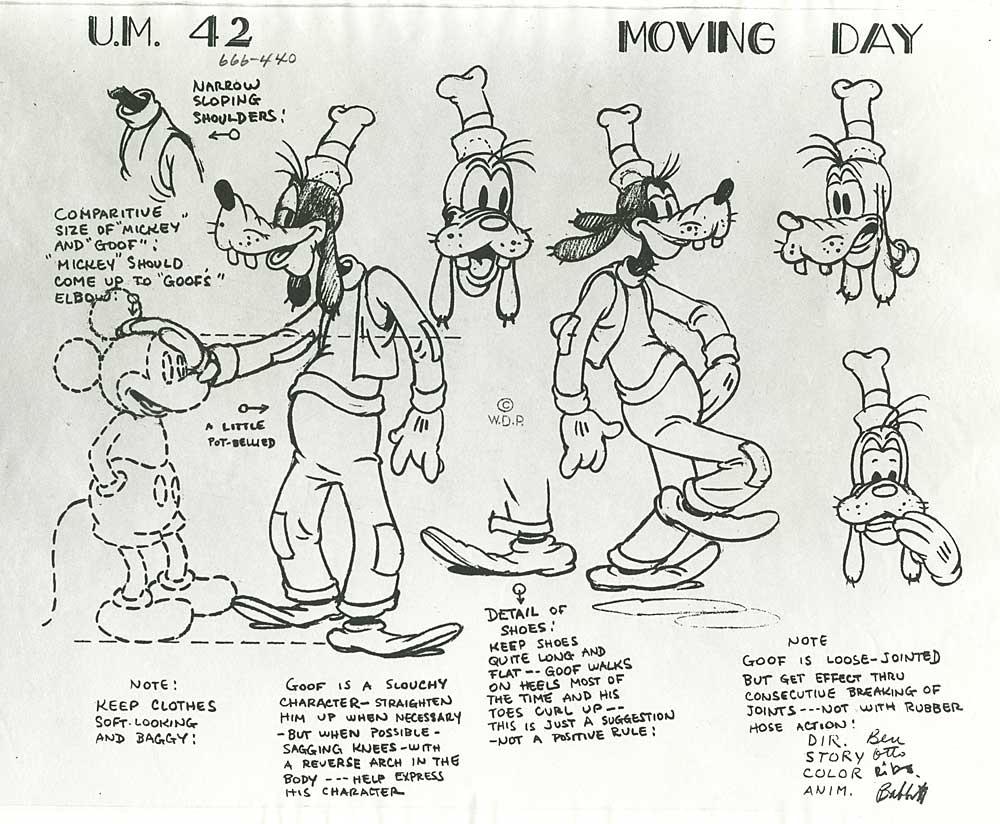
He was a top animator at Disney before and during the production of the greatest animated films of the era, and he also developed Goofy into the character we know today.  He had made his mark BEFORE there WAS a “nine-old-men” qualifier for Disney’s top artists.

He led the infamous Disney labor strike in 1941, which successfully made the Disney studios a union shop.  He was not the orchestrator, but he was the figurehead, and a voluntary martyr for the cause.

Finally, he was the first true innovator of animation education.  You can read about it in my article for the Animation World Network.  In fact, his knack of teaching animation helped develop the skills of a certain studio to animate Who Framed Roger Rabbit, which helped cause the animation renaissance of the late 1980s and reinvigorate the public’s love for the golden age once more.

But what makes Babbitt so fascinating is that there was drama everywhere he went.  From New York’s Depression-ridden inner city to the rising labor unions of Hollywood, to World War II and then the communist witch hunt of the 1950s, Babbitt was a player in some of the most dramatic moments in America’s 20th century. And he wasn’t just a passive player – he was PART of it! He had strong opinions and he wasn’t afraid to act on them. He was a do-er, which, frankly, is the perfect sort of character to write about.

As I study Art Babbitt, I quest for clues about who this person was who could make such an impact, behind the drawing board and in a public forum.  Many items have surfaced in my research that help me learn about the folks who were there that were part of the development of animation. After all, Pixar would not be Pixar if not for the people who made Snow White, and those people had started on crude, flat animation before they began their creative strides. It all started with kitchy flickering drawings on film, and Babbitt was one of the shakers that made animation what it is today.

So if you’ve ever been touched by a piece of animation, a character that may have moved you which was nothing more than a rendered image on a flat screen, I hope you enjoy this chronicle (in blog form) of Art Babbitt.

Posted in miscellaneous | 3 Comments